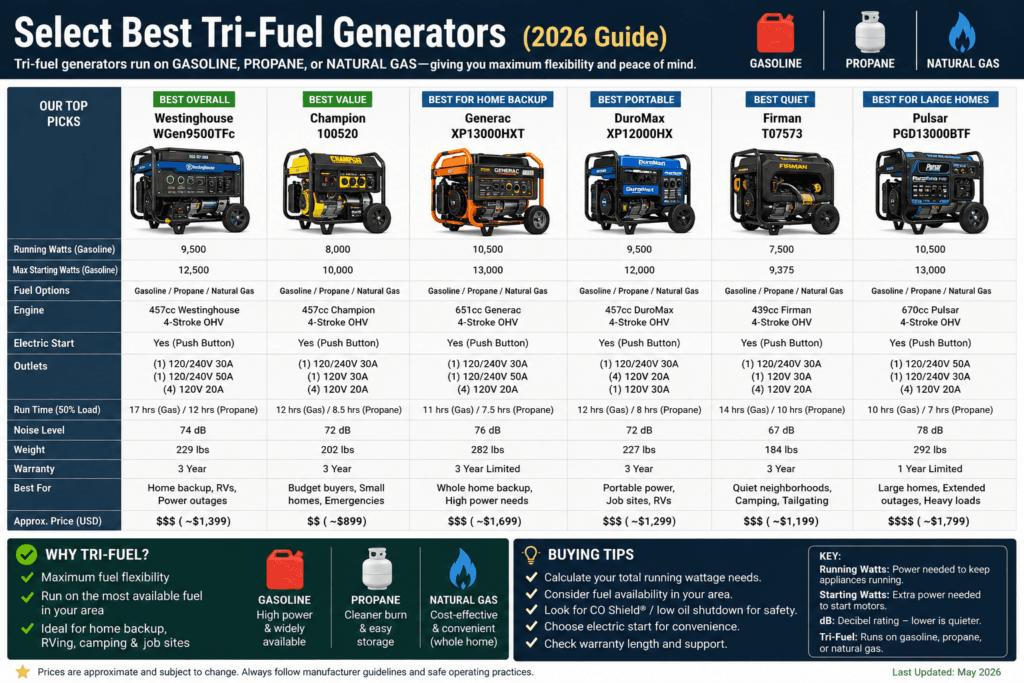
One of the biggest mistakes homeowners make when buying a generator is choosing the wrong size. A generator that’s too small may overload and shut down when you need it most, while a generator that’s much larger than necessary can cost thousands more to purchase and consume more fuel than required.
The good news is that choosing the right generator isn’t difficult once you understand the difference between running watts and starting watts. By calculating the power requirements of the appliances you want to operate during an outage, you can confidently choose a generator that fits both your home and your budget.
Whether you’re looking for a portable generator, inverter generator, solar generator, or whole-house standby generator, this guide will help you determine exactly how many watts you need for reliable home backup power.
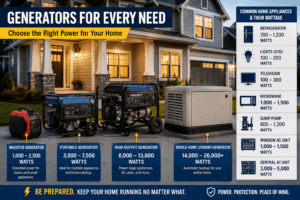
What Are Watts?
A watt (W) is a measurement of electrical power.
Every appliance in your home requires a certain number of watts to operate.
For example:
- Refrigerator
- Freezer
- Microwave
- Television
- Furnace blower
- Well pump
- Lights
- Coffee maker
All use different amounts of electricity.
Your generator must provide enough power to operate all the appliances you plan to use at the same time.
Running Watts vs Starting Watts
Understanding these two terms is the key to proper generator sizing.
Running Watts
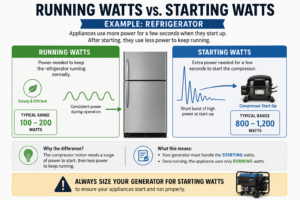
Running watts (also called rated watts) are the amount of electricity an appliance requires while operating normally.
Example:
A refrigerator may require:
- 700 running watts
Once running, it continuously uses approximately this amount of electricity.
Starting Watts
Many appliances with electric motors require extra electricity for a few seconds during startup.
Examples include:
- Refrigerators
- Freezers
- Well pumps
- Air conditioners
- Furnaces
- Sump pumps
A refrigerator using 700 running watts might briefly require 2,100 starting watts when the compressor starts.
Your generator must be able to handle this temporary surge.
Common Appliance Wattage Chart
The following values are general estimates. Always check the manufacturer’s label for the most accurate wattage.
| Appliance | Running Watts | Starting Watts |
|---|---|---|
| Refrigerator | 600–800 | 1,800–2,400 |
| Upright Freezer | 500–700 | 1,500–2,100 |
| Chest Freezer | 500–700 | 1,500–2,100 |
| Microwave | 1,000–1,500 | Same |
| Coffee Maker | 600–1,200 | Same |
| Toaster | 800–1,500 | Same |
| Television | 100–300 | Same |
| Wi-Fi Router | 10–25 | Same |
| Laptop | 50–100 | Same |
| LED Light Bulb | 8–15 | Same |
| Furnace Blower | 600–1,200 | 1,200–2,300 |
| Sump Pump (1/2 HP) | 1,000 | 2,150 |
| Well Pump (1 HP) | 2,000 | 4,000+ |
| Garage Door Opener | 500–700 | 1,000–1,400 |
| Window Air Conditioner | 900–1,500 | 2,000–3,500 |
| Central Air Conditioner | 2,000–5,000+ | 4,000–9,000+ |
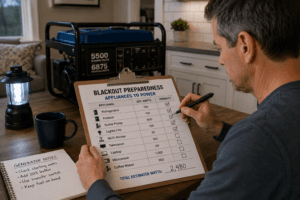
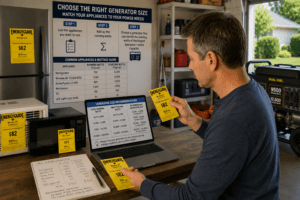
Step 1: Make a List
Write down every appliance you want to operate during a power outage.
Example:
- Refrigerator
- Freezer
- Furnace blower
- Internet modem
- Wi-Fi router
- Television
- Lights
- Microwave
Step 2: Add Running Watts
Example:
| Appliance | Running Watts |
|---|---|
| Refrigerator | 700 |
| Freezer | 600 |
| Furnace | 800 |
| Router | 20 |
| Television | 150 |
| Lights | 120 |
| Microwave | 1,200 |
Total Running Watts = 3,590 Watts
Step 3: Add the Largest Starting Wattage
You generally don’t add the starting wattage for every motorized appliance at once. Instead, account for the largest expected startup surge in addition to the total running load, unless multiple large motors are likely to start simultaneously.
Example:
Refrigerator startup:
+1,400 additional watts
Estimated generator requirement:
Approximately 5,000 watts
Which Generator Size Do You Need?
General recommendations:
2,000–3,000 Watts
Good for:
- Lights
- Phones
- Laptop
- Television
- Small refrigerator
3,500–5,000 Watts
Good for:
- Refrigerator
- Freezer
- Furnace blower
- Lighting
- Internet
- Television
5,000–7,500 Watts
Good for:
- Most essential household appliances
- Sump pumps
- Small well pumps
- Microwave
- Garage door opener
7,500–10,000 Watts
Good for:
- Larger homes
- Multiple refrigerators
- Larger well pumps
- Some central air conditioners
10,000–15,000+ Watts
Good for:
- Large homes
- Multiple HVAC systems
- Extensive backup power
- Nearly all essential household circuits
Generator Sizing Examples
The following examples can help you estimate the generator size needed for different homes and situations.
Example 1: Small Apartment
Appliances:
- Refrigerator
- Wi-Fi router
- Television
- Laptop
- LED lights
- Phone chargers
Estimated running watts:
1,200–2,000 watts
Recommended generator:
- Honda EU2200i Companion
- WEN DF360iX
- Jackery Explorer 2000 Plus
Example 2: Small Home
Appliances:
- Refrigerator
- Freezer
- Furnace blower
- Television
- Internet
- Microwave
- Lighting
Estimated running watts:
3,000–5,000 watts
Recommended generator:
- Westinghouse iGen5000DFc
- Champion 5000-Watt Inverter
- Honda EU7000iS
Example 3: Medium Home
Appliances:
- Refrigerator
- Freezer
- Furnace
- Sump pump
- Microwave
- Lighting
- Internet
- Television
- Garage door opener
Estimated running watts:
5,000–7,500 watts
Recommended generator:
- Champion 7500-Watt Dual Fuel
- DuroMax XP13000HXT
- Predator 9500 Inverter
Example 4: Large Home
Appliances:
- Central air conditioner
- Multiple refrigerators
- Well pump
- Furnace
- Lighting
- Internet
- Microwave
- Water heater
- Medical equipment
Estimated running watts:
8,000–15,000+ watts
Recommended generator:
- Westinghouse WGen11500DFc
- DuroMax XP13000HXT
- Generac Guardian 22kW
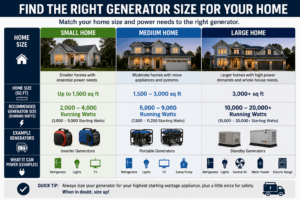
Generator Size by Home Size
| Home Size | Recommended Generator |
|---|---|
| Apartment | 2,000–3,000 Watts |
| Small Home | 3,500–5,000 Watts |
| Medium Home | 5,000–7,500 Watts |
| Large Home | 7,500–12,000 Watts |
| Whole-House Backup | 14kW–26kW+ Standby Generator |
Remember that the size of your home is only a starting point. The number and type of appliances you plan to run determine the generator size you actually need.
Portable vs Standby Generator Sizing
Portable Generators
Portable generators are ideal when you want to power:
- Refrigerators
- Freezers
- Furnaces
- Lights
- Internet equipment
- Small appliances
Common sizes:
- 3,500–9,500 watts
Whole-House Standby Generators
Standby generators are designed to power:
- Entire homes
- Central air conditioning
- Well pumps
- Water heaters
- HVAC systems
- Large appliances
Common sizes:
- 14kW
- 18kW
- 20kW
- 22kW
- 24kW
- 26kW
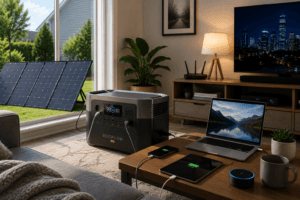
Solar Generator Sizing
Battery capacity is measured in watt-hours (Wh) rather than watts.
General recommendations:
| Battery Capacity | Best For |
|---|---|
| 500–1,000Wh | Phones, lights, laptops |
| 1,000–2,000Wh | Refrigerator, TV, router |
| 2,000–4,000Wh | Multiple household appliances |
| 4,000Wh+ | Serious home backup |
Larger battery systems provide longer runtime but also cost more.
Generator Recommendations by Wattage
Best 2,000-Watt Generator
Honda EU2200i Companion
Best for:
- Camping
- Apartments
- Small refrigerators
- Electronics
Best 5,000-Watt Generator
Westinghouse iGen5000DFc
Best for:
- Small homes
- Refrigerators
- Furnaces
- Home offices
Best 7,500-Watt Generator
Champion 7500-Watt Dual Fuel Generator
Best for:
- Medium homes
- Emergency backup
- Sump pumps
- Multiple appliances
Best 10,000+ Watt Generator
DuroMax XP13000HXT
Best for:
- Large homes
- Well pumps
- Heavy electrical loads
- Extended outages
Best Whole-House Generator
Generac Guardian 22kW
Best for:
- Automatic backup
- Entire home protection
- Long outages
- Families
Generator Sizing Tips
- Always calculate both running watts and starting watts.
- Leave 15–25% extra capacity for future appliances and unexpected loads.
- Check appliance labels instead of relying only on estimates.
- Use your generator’s continuous running watt rating when comparing models.
- If you’re unsure, choose the next larger generator rather than operating near its maximum capacity.
Which Generator Size Is Right for You?
Choose a 2,000–3,000 Watt Generator If:
- You live in an apartment
- You only power electronics and a refrigerator
- Portability is important
Choose a 3,500–5,000 Watt Generator If:
- You have a small home
- You want to power essential appliances
- Quiet inverter power is important
Choose a 5,000–7,500 Watt Generator If:
- You have a medium-sized home
- You want to power a furnace and sump pump
- You need dependable emergency backup
Choose a 10,000+ Watt Generator If:
- You have a large home
- You operate a well pump
- You may run central air conditioning
- You need multiple large appliances at once
Common Generator Sizing Mistakes
Buying the wrong size generator is one of the most common mistakes homeowners make. Understanding these common errors can help you choose a generator that provides dependable backup power without overspending.
Only Looking at Running Watts
Many homeowners add together only the running wattage of their appliances.
This can cause problems because electric motors require extra electricity during startup.
Always calculate:
- Running watts
- Starting watts
This is especially important for:
- Refrigerators
- Freezers
- Well pumps
- Sump pumps
- Air conditioners
- Furnace blowers
Ignoring startup wattage can overload your generator.
Buying Too Small
A generator operating at its maximum capacity all the time can:
- Overload
- Trip breakers
- Consume more fuel
- Experience increased engine wear
Choosing a generator with approximately 15–25% additional capacity helps improve reliability and provides room for future electrical needs.
Buying Much Larger Than Necessary
Bigger isn’t always better.
An oversized generator may:
- Cost considerably more
- Consume additional fuel
- Be heavier
- Require more storage space
Choose a generator that matches your actual backup power requirements rather than simply buying the largest model available.
Forgetting Future Appliances
Think about future electrical needs.
You may eventually add:
- Freezer
- Well pump
- Medical equipment
- Home office
- Additional refrigerator
- Portable air conditioner
Buying slightly larger today may prevent needing another generator later.
Ignoring Fuel Type
Fuel type affects emergency preparedness.
Gasoline
Advantages:
- Widely available
- High power output
Disadvantages:
- Short shelf life
- Requires stabilizer
Propane
Advantages:
- Long storage life
- Cleaner burning
- Lower maintenance
Disadvantages:
- Slightly lower power output
Natural Gas
Advantages:
- Continuous fuel supply
- Excellent for standby generators
Disadvantages:
- Requires natural gas service
Choose a fuel type that fits both your home and your emergency plans.
Forgetting Transfer Switch Costs
Many homeowners budget only for the generator.
If you plan to connect your generator to household circuits, you may also need:
- Transfer switch
- Interlock kit
- Electrical installation
- Permits
- Professional labor
Include these costs in your overall budget.
Skipping Maintenance
Routine maintenance keeps generators ready for emergencies.
Regularly:
- Change engine oil
- Replace air filters
- Inspect spark plugs
- Exercise the generator monthly
- Test electric-start batteries
- Inspect fuel lines
Preventive maintenance helps ensure dependable operation when you need backup power most.
Waiting Until a Storm Is Coming
Generator demand often spikes before:
- Hurricanes
- Ice storms
- Winter storms
- Tornado season
- Major thunderstorms
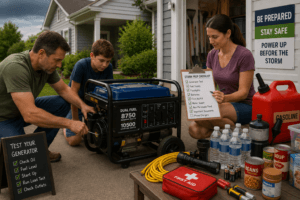
Buying before storm season gives you time to:
- Compare models
- Install a transfer switch
- Practice safe operation
- Store emergency fuel
- Test the generator
Frequently Asked Questions
How do I know what size generator I need?
Start by making a list of every appliance you want to operate during an outage.
Add together:
- Running watts
- The largest expected starting wattage
Then choose a generator with additional capacity to avoid overloads.
Can I run my entire house with a portable generator?
Possibly, but it depends on the generator’s output and your home’s electrical demand.
Many portable generators are designed to power essential circuits, while whole-house standby generators can often power nearly the entire home when properly sized and installed.
Is a 5,000-watt generator enough?
For many homeowners, yes.
A quality 5,000-watt generator can often power:
- Refrigerator
- Freezer
- Furnace blower
- Internet equipment
- Television
- Lighting
- Small kitchen appliances
Large air conditioners, electric water heaters, and well pumps may require additional capacity.
Can a 7,500-watt generator run central air conditioning?
It depends on the size and startup requirements of your air conditioner.
Some smaller central AC systems may operate with a properly sized 7,500-watt generator, while larger systems often require higher-capacity portable generators or standby generators.
What is the difference between watts and watt-hours?
Watts (W) measure power—how much electricity an appliance uses at a given moment.
Watt-hours (Wh) measure stored energy, which is commonly used to describe the battery capacity of portable power stations and solar generators.
Should I buy a larger generator than I currently need?
Buying a generator with some extra capacity is often a good idea. Leaving approximately 15–25% reserve capacity can improve reliability and allow for future appliances without operating the generator at its maximum output continuously.
Final Thoughts
Selecting the correct generator size is one of the most important decisions you’ll make when preparing for a power outage. A properly sized generator provides dependable electricity for your essential appliances while avoiding overloads, reducing fuel consumption, and giving you room for future electrical needs.
For smaller backup needs, compact inverter generators around 2,000 to 3,000 watts can power basic electronics and refrigeration. Homes requiring additional capacity often benefit from generators in the 5,000 to 7,500-watt range, while larger homes with well pumps or central air conditioning may require 10,000 watts or more. Homeowners seeking automatic protection for nearly every household circuit should consider a professionally installed whole-house standby generator.
Before purchasing, make a complete list of the appliances you want to power, verify their running and starting wattage requirements, and choose a generator with enough capacity to handle both your current and future backup power needs. Spending a little extra time calculating your electrical load today can help ensure dependable, worry-free backup power for years to come.