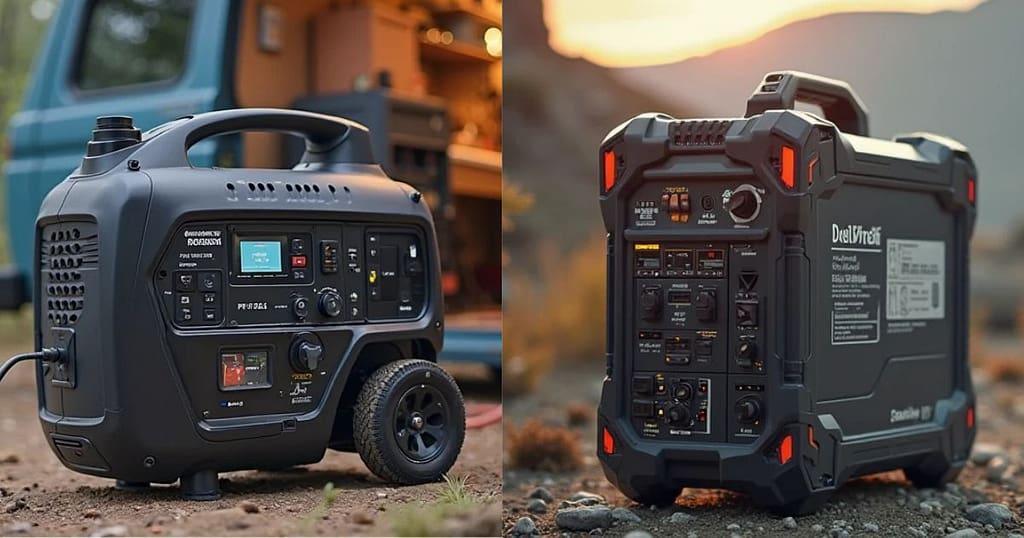
RV camping offers the freedom to explore national parks, campgrounds, forests, beaches, and remote destinations without giving up many of the comforts of home. Whether you’re taking weekend trips or living the RV lifestyle full-time, a dependable generator can provide electricity for air conditioners, microwaves, coffee makers, refrigerators, battery chargers, televisions, lighting, and other essential appliances.
For most RV owners, quiet inverter generators are the preferred choice because they produce clean electricity that’s safe for modern RV electronics while operating much more quietly than traditional open-frame generators. Many newer models also include RV-ready 30-amp outlets, dual-fuel capability, electric start, remote start, carbon monoxide shutdown systems, and parallel capability for additional flexibility. RV-ready generators commonly range from about 2,200 to 5,000 starting watts, though larger fifth wheels and motorhomes may require significantly more power.
In this guide, we’ll compare the best generators for RV camping in 2026, explain which features matter most, and help you choose the right generator for your travel style and power needs.
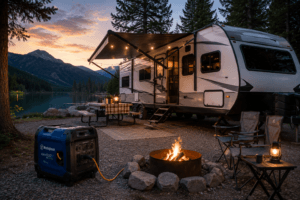
Quick Picks: Best Generators for RV Camping
| Category | Generator | Best For |
|---|---|---|
| Best Overall | Honda EU2200i Companion | Small and medium RVs |
| Best High-Power RV Generator | Champion 9000-Watt Tri-Fuel Inverter Generator | Large fifth wheels and toy haulers |
| Best Dual-Fuel Generator | Westinghouse iGen5000DFc | Flexible RV camping |
| Best Budget Generator | WEN DF360iX Dual Fuel Inverter Generator | Affordable camping |
| Best Portable Power Station | Jackery Explorer 2000 Plus | Quiet camping without gasoline |
Why RV Campers Need a Generator
A quality generator makes camping more comfortable by providing dependable electricity almost anywhere.
An RV generator can power:
- RV air conditioner
- Microwave
- Coffee maker
- Television
- Refrigerator
- Battery charger
- Water pump
- Laptop
- Phone chargers
- Interior lighting
Many RV owners also use generators while boondocking, tailgating, attending races, or staying at campgrounds without electrical hookups.
Best Overall
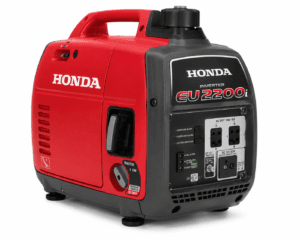
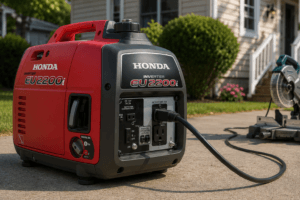
Honda EU2200i Companion
Why We Picked It
The Honda EU2200i Companion has earned a reputation as one of the best RV generators available. It combines exceptional reliability, quiet operation, excellent fuel efficiency, and clean inverter power that’s safe for modern RV electronics.
Its built-in RV-ready outlet and parallel capability make it an excellent choice for travel trailers and smaller motorhomes. Many RV owners also pair two EU2200i Companion units together when additional power is needed for larger air conditioners.
Pros
- Extremely quiet
- Clean inverter power
- Excellent fuel economy
- Lightweight
- Parallel capable
- Outstanding reliability
Cons
- Premium purchase price
- May not power larger RV air conditioners by itself
Best For
- Travel trailers
- Small motorhomes
- Weekend camping
- National parks
- Boondocking
Best High-Power RV Generator
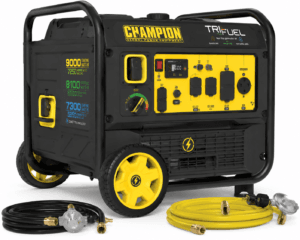
Champion 9000-Watt Tri-Fuel Inverter Generator
Why We Picked It
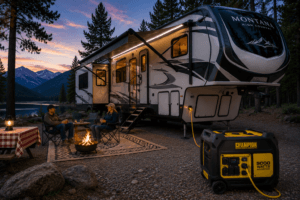
The Champion 9000-Watt Tri-Fuel Inverter Generator provides significantly more power for larger RVs with multiple air conditioners or higher electrical demands. Its ability to operate on gasoline, propane, or natural gas adds valuable flexibility during extended camping trips.
Despite its impressive output, inverter technology helps keep noise levels lower than many traditional portable generators.
Pros
- Tri-fuel capability
- High power output
- Clean inverter electricity
- Electric start
- Remote start
- Excellent surge capacity
Cons
- Heavy
- More expensive than smaller RV generators
Best For
- Fifth wheels
- Toy haulers
- Large travel trailers
- Extended camping
- RVs with multiple air conditioners
Choosing the Right Generator for Your RV
Before purchasing an RV generator, consider:
- RV electrical service (30-amp or 50-amp)
- Air conditioner size
- Running watts
- Starting watts
- Fuel type
- Noise level
- Weight
- Runtime
- Parallel capability
Choosing the right generator helps ensure comfortable camping without carrying more generator than you actually need.
Best Dual-Fuel Generator
Westinghouse iGen5000DFc

Why We Picked It
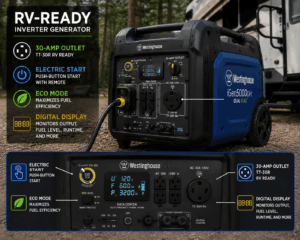
The Westinghouse iGen5000DFc is one of the most versatile RV generators available. It combines quiet inverter technology with the flexibility of operating on either gasoline or propane. It also includes an RV-ready outlet, remote electric start, and clean power that’s safe for modern RV electronics. RV-ready inverter generators like this are popular because they provide the proper 30-amp connection for many campers without requiring adapters.
Pros
- Dual-fuel capability
- Quiet inverter operation
- RV-ready outlet
- Remote electric start
- Clean power for electronics
- Excellent fuel efficiency
Cons
- Heavier than small suitcase generators
- Higher price than conventional generators
Best For
- Travel trailers
- Mid-size RVs
- Boondocking
- Campgrounds
- Extended camping trips
Best Budget Generator
WEN DF360iX Dual Fuel Inverter Generator

Why We Picked It
The WEN DF360iX offers excellent value for RV owners who want quiet inverter power without spending premium Honda prices. Its dual-fuel capability allows operation on either gasoline or propane, while its compact design makes transportation and storage easy.
It provides enough power for battery charging, lights, televisions, microwaves, coffee makers, and many smaller RV air conditioners when properly matched to the RV’s electrical requirements.
Pros
- Affordable
- Dual-fuel capability
- Quiet inverter technology
- Fuel efficient
- Lightweight
- RV-ready design
Cons
- Lower output than larger inverter generators
- May not run larger 15,000 BTU air conditioners by itself
Best For
- Weekend camping
- Small travel trailers
- Pop-up campers
- Budget-conscious RV owners
Best Portable Power Station
Jackery Explorer 2000 Plus

Why We Picked It
The Jackery Explorer 2000 Plus offers silent, battery-powered electricity without gasoline or exhaust fumes. It’s ideal for campers who want quiet operation while charging phones, laptops, cameras, CPAP machines, lights, televisions, portable refrigerators, and other small appliances.
When paired with solar panels, it can provide renewable energy throughout extended camping trips.
Pros
- Completely silent
- Indoor safe
- Expandable battery capacity
- Solar compatible
- Fast charging
- No fuel required
Cons
- Limited runtime for air conditioners
- Higher upfront investment
Best For
- National parks
- Quiet campgrounds
- Tent camping
- RV battery charging
- Off-grid camping
Generator Comparison
| Generator | Fuel Type | Inverter | Best For |
|---|---|---|---|
| Honda EU2200i Companion | Gasoline | ✔ | Best Overall |
| Champion 9000-Watt Tri-Fuel Inverter | Tri-Fuel | ✔ | Large RVs |
| Westinghouse iGen5000DFc | Gasoline / Propane | ✔ | Best Dual-Fuel |
| WEN DF360iX | Gasoline / Propane | ✔ | Best Budget |
| Jackery Explorer 2000 Plus | Battery + Solar | N/A | Silent Camping |
For many RV owners, inverter generators remain the preferred option because they provide cleaner electricity, quieter operation, and improved fuel efficiency compared to conventional generators.
Fuel Options
Gasoline
Advantages:
- Widely available
- High power output
- Easy to refuel
Disadvantages:
- Limited shelf life
- Requires fuel stabilizer
- Louder refueling logistics during long trips
Propane
Advantages:
- Long shelf life
- Cleaner burning
- Lower maintenance
- Easy cylinder replacement
Disadvantages:
- Slightly lower power output
- Requires carrying propane cylinders
Solar Battery Power
Advantages:
- Completely silent
- No fuel required
- No exhaust emissions
- Low maintenance
- Renewable energy
Disadvantages:
- Limited runtime
- Solar charging depends on sunlight
RV Generator Safety Tips
Always operate generators safely while camping.
- Operate generators outdoors only.
- Keep generators well away from the RV, neighboring campsites, doors, windows, and vents.
- Never run a generator inside the RV or underneath the camper.
- Allow the generator to cool before refueling.
- Use only heavy-duty outdoor-rated extension cords if needed.
- Follow campground quiet hours and generator-use policies.
Modern generators equipped with carbon monoxide shutoff provide an additional layer of safety, but they do not replace proper placement and ventilation.
Which Generator Is Best?
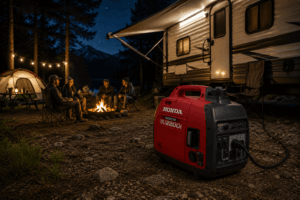
Choose the Honda EU2200i Companion If:
- You have a small or medium RV
- Quiet operation is your top priority
- You frequently camp in national parks
- Portability matters
Choose the Champion 9000-Watt Tri-Fuel Inverter Generator If:
- You own a large fifth wheel
- You need to run multiple air conditioners
- Maximum power is important
- Fuel flexibility is a priority
Choose the Westinghouse iGen5000DFc If:
- You want dual-fuel capability
- Quiet operation is important
- You camp frequently
- You need an RV-ready outlet
Choose the WEN DF360iX If:
- Budget is your biggest concern
- You own a smaller camper
- You want inverter power
- You value portability
Choose the Jackery Explorer 2000 Plus If:
- Silent camping is important
- You camp where generator restrictions apply
- You primarily power electronics and small appliances
Features to Look For
The best RV generator isn’t always the one with the highest wattage. Instead, it should provide enough power for your RV while remaining quiet, fuel-efficient, easy to transport, and compatible with your electrical system.
Here are the most important features to compare before purchasing an RV generator.
Inverter Technology
Most experienced RV owners recommend inverter generators.
Benefits include:
- Quiet operation
- Clean electricity
- Better fuel efficiency
- Stable voltage
- Safe for sensitive electronics
Inverter generators are ideal for powering:
- RV air conditioners
- Microwaves
- Televisions
- Laptops
- Coffee makers
- CPAP machines
- Battery chargers
- Wi-Fi equipment
They are also much more campground-friendly than traditional open-frame generators.
RV-Ready Outlet
Many RV generators include a built-in 30-amp TT-30 RV outlet.
Benefits include:
- Direct RV connection
- Fewer adapters
- Easier setup
- Safer connections
If you own a 50-amp RV, verify whether your generator supports a 50-amp connection or whether adapters will be required.
Parallel Capability
Many smaller inverter generators can operate together using a parallel kit.
Benefits include:
- Double the available power
- Easier transportation
- Greater flexibility
- Better fuel economy during lighter loads
Many RV owners purchase one generator initially and add a second later if additional air conditioning capacity is needed.
Dual-Fuel or Tri-Fuel Capability
Fuel flexibility is especially useful during extended camping trips.
Dual-Fuel
Operates on:
- Gasoline
- Propane
Tri-Fuel
Operates on:
- Gasoline
- Propane
- Natural gas (where available)
Advantages include:
- Easier fuel management
- Longer propane storage
- Cleaner engine operation
- Greater emergency flexibility
Quiet Operation
Noise is one of the most important considerations for RV camping.
Many campgrounds have:
- Quiet hours
- Generator restrictions
- Noise limits
Lower-noise generators improve:
- Camping comfort
- Neighbor relations
- Overall campground experience
Electric Start
Electric start provides:
- Push-button operation
- Faster setup
- Easier restarting
- Less physical effort
Remote start adds even more convenience.
Long Runtime
Compare:
- Fuel tank size
- Runtime at 25% load
- Runtime at 50% load
Longer runtime means:
- Less refueling
- Better overnight performance
- Greater convenience during long camping trips
Carbon Monoxide (CO) Shutdown
Many modern RV generators include built-in carbon monoxide monitoring.
If unsafe CO levels are detected around the generator, the engine automatically shuts down.
Always operate generators outdoors and well away from your RV, neighboring campsites, doors, windows, slide-outs, and vents. Never operate a generator inside an RV, enclosed trailer, truck bed with a closed cover, garage, or any enclosed area.
Portability
Most RV owners move their generator frequently.
Helpful portability features include:
- Built-in wheels
- Folding handles
- Lightweight construction
- Compact suitcase design
Smaller generators are easier to load into RV storage compartments.
Common Buying Mistakes
Avoid these common mistakes before purchasing an RV generator.
Buying Too Small
Many RV owners forget to calculate startup wattage.
Always include:
- Air conditioner startup
- Microwave
- Refrigerator
- Converter/charger
- Television
- Coffee maker
- Future appliances
Starting watts can be significantly higher than running watts for some appliances.
Buying Too Large
Oversized generators:
- Cost more
- Consume more fuel
- Take up valuable storage space
- Weigh considerably more
Choose the smallest generator that comfortably handles your RV’s electrical needs.
Ignoring Campground Noise Rules
Some campgrounds prohibit loud generators.
Quiet inverter generators are often the best choice for:
- National parks
- State parks
- Private campgrounds
- RV resorts
Forgetting Fuel Storage
Before every trip:
- Fill the fuel tank
- Inspect oil level
- Carry approved fuel containers if permitted
- Check extension cords
- Test generator operation
Preparation helps avoid problems after arriving at your campsite.
Skipping Maintenance
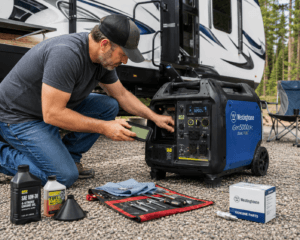
Routine maintenance keeps generators dependable.
Regularly:
- Change engine oil
- Clean air filters
- Inspect spark plugs
- Exercise the generator
- Check fuel condition
- Inspect battery (electric-start models)
Routine maintenance helps maximize reliability during every camping trip.
Ignoring Weather Protection
Portable generators should never operate in standing water or be exposed directly to heavy rain.
If weather protection is needed:
- Use a generator canopy or cover specifically designed for safe generator operation.
- Never block airflow or ventilation openings.
Frequently Asked Questions
What size generator do I need for my RV?
It depends on your RV and the appliances you plan to operate.
Many travel trailers can be supported by generators in the 2,000 to 4,500 running watt range, while larger fifth wheels and motorhomes with multiple air conditioners may require 5,000 to 9,000 watts or more.
Always calculate both running and starting wattage before buying.
Can a Honda EU2200i run an RV air conditioner?
It depends on the air conditioner and its startup requirements.
Some smaller RV air conditioners may operate with a single Honda EU2200i Companion, especially if a compatible soft-start device is installed. Larger air conditioners often require a higher-capacity generator or two compatible inverter generators connected in parallel.
Are inverter generators better for RV camping?
Yes.
Most RV owners prefer inverter generators because they provide:
- Quiet operation
- Clean electricity
- Better fuel economy
- Safe power for electronics
Is propane better than gasoline?
Both fuels work well.
Propane offers:
- Long shelf life
- Cleaner combustion
- Lower maintenance
Gasoline offers:
- Slightly higher power output
- Easy availability
Dual-fuel generators provide the flexibility to use either fuel.
Can I leave my generator running overnight?
Always follow the generator manufacturer’s instructions and your campground’s rules. Some campgrounds prohibit overnight generator operation during quiet hours, while others have designated times when generators may be used.
How often should I maintain my RV generator?
Follow the manufacturer’s maintenance schedule. If you camp frequently, inspect the generator before every trip and perform oil changes, air filter service, and spark plug replacement at the recommended intervals.
Final Thoughts
A dependable generator can make RV camping far more comfortable by providing reliable electricity wherever your travels take you. Whether you’re camping in a national park, boondocking in the desert, or staying at a full-service campground, the right generator helps keep your appliances, electronics, and comfort systems operating throughout your trip.
For most RV owners, the Honda EU2200i Companion remains one of the best overall choices thanks to its outstanding reliability, quiet inverter technology, and portability. Owners of larger RVs with higher electrical demands should consider the Champion 9000-Watt Tri-Fuel Inverter Generator, while the Westinghouse iGen5000DFc offers an excellent combination of quiet operation and dual-fuel flexibility. Budget-conscious campers will appreciate the WEN DF360iX Dual Fuel Inverter Generator, and those seeking completely silent operation should consider the Jackery Explorer 2000 Plus paired with compatible solar panels.
Before purchasing, calculate your RV’s electrical requirements, check your campground’s generator regulations, and choose a generator with enough capacity for both your current and future camping needs. A well-matched generator can provide years of dependable power and make every adventure more enjoyable.