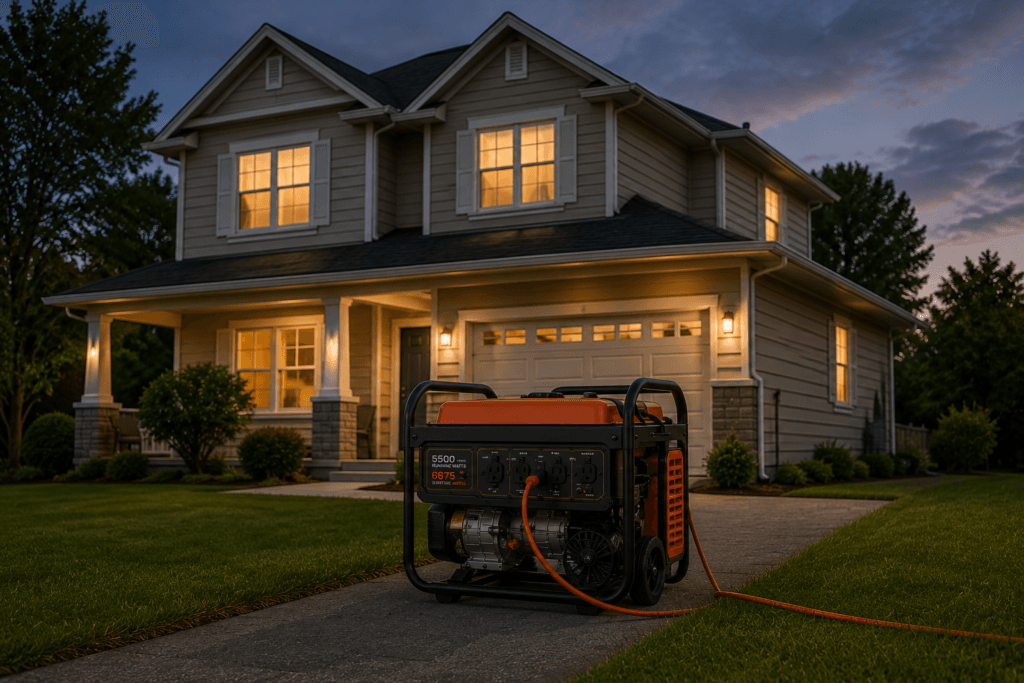
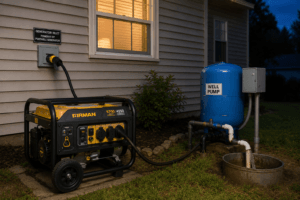
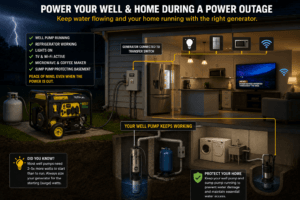
Losing power when your home relies on a private well means more than losing electricity—you also lose access to running water. Without power, your well pump can’t supply water for drinking, cooking, showers, flushing toilets, or washing clothes.
Choosing the right generator for a well pump isn’t as simple as matching the pump’s horsepower. Electric motors require a large burst of power when they start, known as starting (surge) wattage, which is often 3–5 times higher than the normal running wattage. If your generator can’t provide enough starting power, the pump may fail to start or trip the generator’s breaker.
The good news is that most residential well pumps can be powered by a properly sized portable generator. By knowing your pump’s horsepower, voltage, and startup requirements, you can confidently choose a generator that keeps your water flowing during an outage.
In this guide, you’ll learn how much power different well pumps require, what size generator works best for each pump size, common sizing mistakes to avoid, and our top generator recommendations for dependable well pump backup.
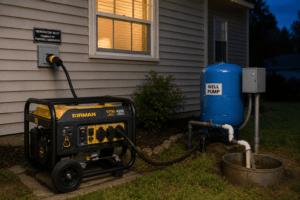
Quick Picks: Best Generators for Well Pumps
| Category | Generator | Best For |
|---|---|---|
| Best Overall | DuroMax XP13000HXT Tri-Fuel Generator | Most homes with well pumps |
| Best Dual-Fuel | Westinghouse WGen11500DFc | Well pump plus household backup |
| Best Tri-Fuel | Predator 13,000-Watt Tri-Fuel Generator | Homes with natural gas service |
| Best Inverter Generator | Honda EU7000iS | Quiet operation and clean power |
| Best Budget Generator | Champion 7500-Watt Dual Fuel | Smaller well pumps and essentials |
Why Well Pumps Need Larger Generators
Unlike lights or televisions, well pumps use electric motors that require a significant surge of electricity when they first start.
While a pump may only consume 1,000 watts while running, it could briefly require 3,000 to 5,000 watts during startup.
This is why generator sizing should always be based on starting wattage, not just running wattage. Selecting a generator with extra capacity also helps if you plan to run additional appliances at the same time.
Advantages of Choosing the Right Generator
- Reliable water supply during outages
- Prevents generator overloads
- Helps protect pump motors
- Allows additional appliances to run
- Improves long-term generator performance
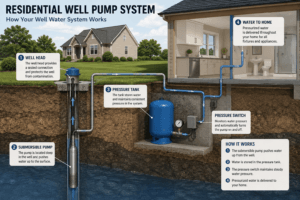
The exact power requirements depend on your pump’s horsepower, voltage, and design.
| Well Pump Size | Running Watts | Starting Watts |
|---|---|---|
| 1/3 HP | 700–900 | 2,000–2,500 |
| 1/2 HP | 900–1,200 | 2,500–3,500 |
| 3/4 HP | 1,200–1,700 | 3,500–5,000 |
| 1 HP | 2,000–2,500 | 5,000–7,000 |
| 1.5 HP | 2,500–3,500 | 6,500–9,000 |
| 2 HP | 3,000–4,000 | 8,000–10,000 |
These values are general estimates. Always check your pump’s nameplate or owner’s manual for the exact requirements.
Best Overall
DuroMax XP13000HXT Tri-Fuel Generator

Why We Picked It
The DuroMax XP13000HXT is one of the best generators for homeowners with private wells because it combines excellent starting wattage with tri-fuel flexibility. It can easily handle many residential well pumps while also powering refrigerators, freezers, lighting, and other essential household circuits.
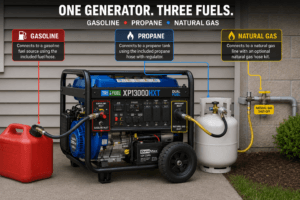
Its ability to operate on gasoline, propane, or natural gas makes it especially useful during extended outages.
Pros
- Tri-fuel capability
- Excellent surge capacity
- Electric start
- Transfer switch compatible
- Long runtime
- Ideal for well pump backup
Cons
- Heavy unit
- Louder than inverter generators
Best For
- Well pumps
- Rural homes
- Large homes
- Extended outages
- Whole-home essentials
Best Dual-Fuel Generator
Westinghouse WGen11500DFc

Why We Picked It
The Westinghouse WGen11500DFc offers plenty of starting power for many 1 HP residential well pumps while also providing enough capacity to run refrigerators, freezers, lighting, and additional household appliances.
Dual-fuel capability allows homeowners to switch between gasoline and propane depending on fuel availability.
Pros
- Dual-fuel operation
- Remote electric start
- High surge wattage
- Excellent reliability
- Long runtime
Cons
- Large footprint
- Heavy to transport
Best For
- Well pumps
- Home backup
- Rural properties
- Multi-day outages
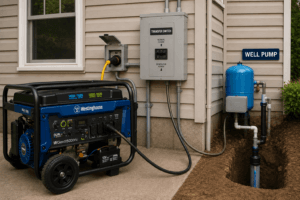
Choosing the Right Generator for Your Well Pump
Before purchasing a generator, determine:
- Pump horsepower
- Pump voltage (120V or 240V)
- Running watts
- Starting watts
- Additional appliances you want to power
- Generator fuel type
- Transfer switch compatibility
Taking these factors into account helps ensure reliable water service and reduces the risk of overloading your generator during emergencies.
What Size Generator for a Well Pump? (2026 Complete Guide)
Part 2
Best Tri-Fuel Generator
Predator 13,000-Watt Tri-Fuel Generator

Why We Picked It
The Predator 13,000-Watt Tri-Fuel Generator offers outstanding flexibility for homeowners with private wells. Its ability to run on gasoline, propane, or natural gas makes it an excellent choice for long-term emergency preparedness.
With its high starting wattage, it’s capable of handling many residential well pumps while also powering refrigerators, freezers, sump pumps, lighting, HVAC systems, and other household appliances.
Pros
- Tri-fuel capability
- Excellent surge wattage
- Electric and remote start
- Long runtime
- Great value
- Carbon monoxide shutdown
Cons
- Heavy generator
- Louder than inverter generators
Best For
- Large homes
- Well pumps
- Rural properties
- Natural gas users
- Extended outages
Best Inverter Generator
Honda EU7000iS

Why We Picked It
The Honda EU7000iS delivers exceptionally clean electricity that’s ideal for homeowners wanting to protect sensitive electronics while still powering many smaller residential well pumps.
Although it doesn’t produce the highest wattage in this guide, its quiet operation, outstanding fuel efficiency, and legendary reliability make it one of the finest inverter generators available.
Pros
- Extremely quiet
- Clean inverter power
- Excellent fuel efficiency
- Electric start
- Reliable Honda engine
Cons
- Premium price
- Not ideal for larger 1½–2 HP well pumps
Best For
- Smaller well pumps
- Home offices
- Medical equipment
- Quiet neighborhoods
Best Budget Generator
Champion 7500-Watt Dual Fuel Generator

Why We Picked It
The Champion 7500-Watt Dual Fuel Generator provides dependable backup power at an affordable price. It offers enough surge capacity for many ½ HP and ¾ HP residential well pumps while also supplying electricity for refrigerators, lighting, internet equipment, and other essential appliances.
Pros
- Affordable
- Dual-fuel operation
- Electric start
- Reliable engine
- Easy maintenance
Cons
- Lower capacity than premium models
- Louder than inverter generators
Best For
- Smaller homes
- Budget-conscious buyers
- Essential backup power
- Smaller well pumps
Recommended Generator Size by Well Pump Horsepower
Choosing the right generator starts with knowing your pump’s horsepower.
1/3 HP Well Pump
Recommended Generator:
2,500–3,500 Watts
Typically powers:
- Small well pump
- Refrigerator
- LED lighting
- Phone chargers
1/2 HP Well Pump
Recommended Generator:
3,500–5,000 Watts
Can often power:
- Well pump
- Refrigerator
- Freezer
- Internet equipment
- Lighting
3/4 HP Well Pump
Recommended Generator:
5,000–7,500 Watts
Often powers:
- Well pump
- Refrigerator
- Furnace blower
- Lighting
- Television
- Small appliances
1 HP Well Pump
Recommended Generator:
7,500–10,000 Watts
Can often operate:
- Well pump
- Refrigerator
- Freezer
- Furnace
- Sump pump
- Kitchen appliances
1½–2 HP Well Pump
Recommended Generator:
10,000–13,000+ Watts
Ideal for:
- Larger well pumps
- Central air (load dependent)
- Septic pump
- Multiple refrigerators
- Whole-home essentials
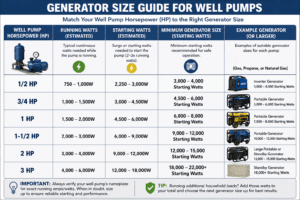
Generator Sizing Chart
| Well Pump Size | Recommended Generator Size |
|---|---|
| 1/3 HP | 2,500–3,500 watts |
| 1/2 HP | 3,500–5,000 watts |
| 3/4 HP | 5,000–7,500 watts |
| 1 HP | 7,500–10,000 watts |
| 1½ HP | 10,000–13,000 watts |
| 2 HP | 13,000+ watts |
Portable Generator vs. Standby Generator
Portable Generator
Advantages:
- Lower cost
- Easy to store
- Flexible use
- Available in dual-fuel and tri-fuel models
- Excellent for emergency preparedness
Standby Generator
Advantages:
- Automatic startup
- No manual refueling during operation (natural gas or large propane supply)
- Whole-home protection
- Excellent for frequent outages
Portable generators remain the most popular solution for homeowners with private wells because they provide excellent performance at a much lower purchase price.
Gasoline vs. Propane vs. Natural Gas
Gasoline
Advantages:
- Widely available
- High energy content
- Maximum generator output
Disadvantages:
- Limited storage life
- Requires fuel stabilizer for long-term storage
Propane
Advantages:
- Long shelf life
- Cleaner burning
- Easier long-term storage
Disadvantages:
- Slightly reduced generator output compared to gasoline
Natural Gas
Advantages:
- Continuous fuel supply (where available)
- No refueling
- Excellent for extended outages
Disadvantages:
- Requires natural gas service
- Slightly lower power output than gasoline
Tips for Reliable Well Pump Backup Power
To improve reliability during outages:
- Test your generator monthly
- Keep fresh fuel available
- Install a transfer switch or interlock kit
- Store extra engine oil
- Inspect extension cords regularly
- Know your well pump’s horsepower
- Leave extra generator capacity for future appliances
Being prepared before an outage helps ensure your family continues to have access to clean running water when utility power is unavailable.
Features to Look For
The best generator for a well pump isn’t necessarily the one with the highest wattage. Choosing a model with the right features can improve safety, convenience, fuel efficiency, and long-term reliability during power outages.
When comparing generators for well pump backup, look for the following features.
High Starting Wattage
Well pumps require a large surge of electricity when they first start.
Choose a generator with enough starting wattage to handle your pump’s startup demand plus any additional appliances you plan to operate.
Buying a generator with some extra capacity helps prevent overloads and provides room for future electrical needs.
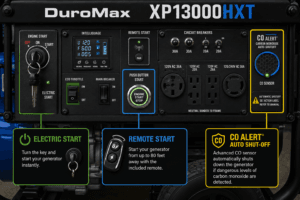
Electric Start
Electric start makes operating a generator much easier than using a recoil starter.
Benefits
- Push-button starting
- Easier during severe weather
- Less physical effort
- Faster emergency operation
Remote Start
Some larger portable generators include wireless remote start capability.
Benefits
- Start the generator from a short distance away
- Convenient during rain or snow
- Faster emergency startup
Carbon Monoxide (CO) Shutdown
Many modern generators include built-in carbon monoxide detection systems.
If dangerous levels of carbon monoxide accumulate around the generator, the engine automatically shuts down.
Always operate generators outdoors, well away from doors, windows, garages, crawl spaces, and vents. Never operate a generator inside an enclosed building.
Transfer Switch Compatibility
If you plan to power your home’s well pump through your electrical system, choose a generator compatible with a transfer switch or interlock kit.
Benefits include:
- Safer home connection
- No extension cords throughout the house
- Easier operation
- Protection against dangerous backfeeding
Fuel Gauge
A fuel gauge makes it easy to monitor fuel levels during long outages.
Benefits include:
- Better fuel planning
- Reduced risk of unexpected shutdowns
- Easier refueling schedule
Low-Oil Shutdown
Low-oil shutdown automatically protects the engine by turning it off before oil levels become dangerously low.
This feature helps extend engine life and reduce expensive repairs.
Multiple Outlet Options
Many generators include a variety of outlet types, including:
- 120V household outlets
- 120/240V outlets
- 30-amp locking outlets
- 50-amp outlets
- RV outlets
- USB charging ports (on some models)
Having multiple outlet options increases flexibility during emergencies.
Common Generator Buying Mistakes
Avoid these common mistakes when selecting a generator for your well pump.
Buying Too Small
Many homeowners calculate only the pump’s running watts.
Always account for:
- Starting watts
- Additional household appliances
- Future electrical needs
A slightly larger generator is often a better long-term investment.
Ignoring Startup Surge
Well pumps may require three to five times more electricity during startup than during normal operation.
If your generator cannot supply this surge, the pump may fail to start or trip the generator’s breaker.
Forgetting Other Essential Appliances
Many homeowners want to power more than just their well pump.
Common additional loads include:
- Refrigerator
- Freezer
- Furnace blower
- Internet equipment
- Lighting
- Sump pump
- Septic pump
Add these loads to your generator sizing calculations.
Ignoring Fuel Storage
Extended outages often require more fuel than expected.
Prepare by:
- Storing gasoline safely
- Keeping propane tanks full
- Using fuel stabilizer
- Rotating stored fuel regularly
Tri-fuel generators connected to natural gas can significantly reduce refueling requirements.
Skipping Maintenance
Routine maintenance greatly improves generator reliability.
Follow the manufacturer’s maintenance schedule and regularly:
- Change engine oil
- Replace air filters
- Inspect spark plugs
- Check battery condition
- Exercise the generator monthly
- Inspect fuel lines
A well-maintained generator is far more likely to perform when you need it most.
Waiting Until Storm Season
Generators frequently sell out before major storms.
Buying early allows you to:
- Compare more models
- Learn how the generator operates
- Test it under load
- Install a transfer switch
- Build an emergency fuel supply
Frequently Asked Questions
Will a 3,500-watt generator run a well pump?
It depends on the pump size. Many 1/3 HP and some 1/2 HP well pumps can operate on a properly sized 3,500-watt generator, but always verify the pump’s starting wattage before purchasing.
What size generator do I need for a 1 HP well pump?
Many 1 HP well pumps require a generator in the 7,500 to 10,000-watt range to handle startup surge while leaving capacity for additional household appliances.
Can a generator damage a well pump?
No. A properly sized generator that provides stable electrical power is generally safe for well pumps when used according to the manufacturer’s recommendations.
Can I power my well pump and refrigerator at the same time?
Yes. Many generators can operate both appliances simultaneously if they have adequate starting and running wattage.
Is a dual-fuel generator worth buying?
For many homeowners, yes. The ability to operate on gasoline or propane provides valuable flexibility during extended outages.
How often should I test my generator?
Run your generator for 20–30 minutes once each month under a moderate electrical load. Regular testing helps ensure it will start and operate properly during an emergency.
Final Thoughts
If your home depends on a private well, choosing the right generator is essential for maintaining access to clean running water during a power outage. The most important factor is selecting a generator with enough starting wattage to handle your well pump’s surge requirements while also leaving capacity for the other appliances you need most.
For many homeowners, the DuroMax XP13000HXT Tri-Fuel Generator stands out as the best overall choice thanks to its impressive starting power, excellent fuel flexibility, and ability to support well pumps alongside essential household circuits. The Westinghouse WGen11500DFc is another excellent option for homeowners looking for dependable dual-fuel performance, while the Champion 7500-Watt Dual Fuel Generator offers outstanding value for smaller well pump systems.
Before purchasing, verify your well pump’s horsepower, voltage, and starting wattage, then choose a generator that comfortably exceeds those requirements. A properly sized generator can provide dependable water service and valuable peace of mind throughout even the longest power outages.