Best Generators for Off-Grid Living (2026 Guide)
Living off the grid offers independence, self-sufficiency, and freedom from traditional utility companies. Whether you own a remote cabin, an off-grid home, a hunting property, or a homestead, having a dependable generator is often essential for maintaining reliable electricity—especially during periods of poor solar production or increased power demand.
While many off-grid properties rely primarily on solar panels and battery storage, generators remain an important backup power source. They can recharge battery banks, operate heavy electrical loads, power well pumps, run power tools, and provide electricity during extended periods of cloudy weather. Modern generators now offer features such as dual-fuel and tri-fuel capability, inverter technology, remote start, electric start, and excellent fuel efficiency, making them more practical than ever for off-grid applications. Recent testing continues to show that high-quality inverter generators and high-capacity portable generators are among the best options for off-grid living, depending on your energy needs.
In this guide, we’ll compare the best generators for off-grid living in 2026, explain which features matter most, and help you choose the right generator for your cabin, homestead, or remote property.
 ]
]
Quick Picks: Best Generators for Off-Grid Living
| Category | Generator | Best For |
|---|---|---|
| Best Overall | Honda EU7000iS | Reliable everyday off-grid power |
| Best High-Output Generator | DuroMax XP13000HXT Tri-Fuel Generator | Large off-grid homes |
| Best Inverter Generator | Westinghouse iGen5000DFc | Quiet battery charging |
| Best Budget Generator | Champion 7500-Watt Dual Fuel Generator | Affordable off-grid backup |
| Best Solar Companion | EcoFlow DELTA Pro 3 + Solar Panels | Hybrid off-grid systems |
Why Off-Grid Homes Need a Generator
Even homes with large solar systems benefit from having a generator.
A generator can help:
- Recharge battery banks
- Operate well pumps
- Power heavy appliances
- Run shop equipment
- Support construction projects
- Provide backup during cloudy weather
- Handle seasonal increases in power demand
- Supply emergency electricity
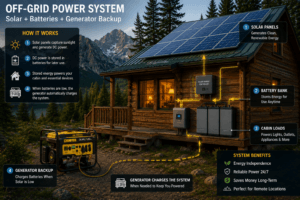
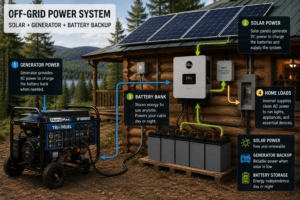
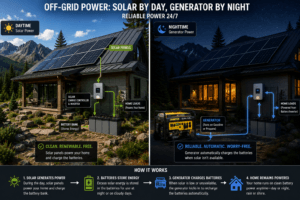
Many experienced off-grid homeowners use a generator as part of a hybrid energy system rather than relying on solar power alone.
Best Overall
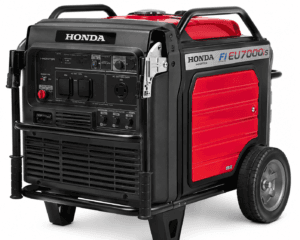
Honda EU7000iS
Why We Picked It
The Honda EU7000iS has earned an outstanding reputation for reliability, quiet operation, and fuel efficiency. Its clean inverter power is ideal for charging battery banks, powering sensitive electronics, operating refrigerators, freezers, lighting, and many everyday household appliances.
Its dependable engine and long service life make it one of the best long-term investments for off-grid living.
Pros
- Extremely reliable
- Quiet operation
- Clean inverter power
- Excellent fuel economy
- Electric start
- Outstanding resale value
Cons
- Premium purchase price
- Gasoline only
Best For
- Off-grid cabins
- Battery charging
- Everyday household power
- Long-term ownership
Best High-Output Generator
DuroMax XP13000HXT Tri-Fuel Generator

The DuroMax XP13000HXT is an excellent option for larger off-grid homes with greater electrical demands. Its tri-fuel capability allows operation on gasoline, propane, or natural gas (where available), providing exceptional flexibility.
Its high output makes it capable of operating well pumps, air compressors, power tools, large refrigerators, freezers, and many additional household circuits.
Pros
- Tri-fuel capability
- High surge capacity
- Electric start
- Excellent emergency backup
- Transfer switch compatible
- Outstanding overall value
Cons
- Heavy
- Louder than inverter generators
Best For
- Large off-grid homes
- Workshops
- Homesteads
- Heavy electrical loads
Choosing the Right Off-Grid Generator
Before purchasing a generator for off-grid living, consider:
- Daily electrical usage
- Battery bank size
- Solar panel capacity
- Fuel availability
- Noise level
- Runtime
- Portability
- Future expansion plans
- Maintenance requirements
Choosing the right generator helps ensure dependable power throughout every season while complementing your renewable energy system.
Best Inverter Generator
Westinghouse iGen5000DFc

Why We Picked It
The Westinghouse iGen5000DFc is an excellent off-grid generator because it combines quiet inverter technology with the flexibility of dual-fuel operation. It produces clean electricity that’s ideal for charging battery banks, powering refrigerators, freezers, computers, lighting, and other sensitive electronics.
Its relatively quiet operation makes it especially well suited for cabins and remote properties where minimizing noise is important.
Pros
- Dual-fuel capability
- Quiet inverter operation
- Clean power for electronics
- Fuel efficient
- Electric start
- Long runtime
Cons
- Lower maximum output than large open-frame generators
- Higher purchase price than conventional generators
Best For
- Off-grid cabins
- Battery bank charging
- Solar backup systems
- Quiet operation
- Everyday power
Best Budget Generator
Champion 7500-Watt Dual Fuel Generator

Why We Picked It
The Champion 7500-Watt Dual Fuel Generator offers dependable backup power at an affordable price. It provides enough power for well pumps, refrigerators, freezers, lighting, power tools, and other household essentials while allowing operation on either gasoline or propane.
Its excellent value makes it a popular choice for first-time off-grid homeowners.
Pros
- Affordable
- Dual-fuel capability
- Electric start
- Reliable engine
- Excellent customer support
- Strong value
Cons
- Louder than inverter generators
- Less fuel efficient under lighter loads
Best For
- Budget-conscious buyers
- Homesteads
- Emergency backup
- Weekend cabins
Best Solar Companion
EcoFlow DELTA Pro 3 + Solar Panels

Why We Picked It
The EcoFlow DELTA Pro 3 works exceptionally well alongside an off-grid generator. During sunny weather, solar panels recharge the battery system, while the generator can provide supplemental charging during cloudy conditions or periods of high electrical demand.
This hybrid approach reduces fuel consumption while increasing overall energy independence.
Pros
- Silent operation
- Solar compatible
- Expandable battery capacity
- Fast charging
- Indoor operation
- Smart energy management
Cons
- Higher upfront investment
- Battery runtime depends on capacity and electrical load
Best For
- Solar-powered cabins
- Hybrid energy systems
- Quiet backup
- Remote homes
Generator Comparison
| Generator | Fuel Type | Inverter | Best For |
|---|---|---|---|
| Honda EU7000iS | Gasoline | ✔ | Best Overall |
| DuroMax XP13000HXT | Tri-Fuel | ✘ | Large Off-Grid Homes |
| Westinghouse iGen5000DFc | Dual Fuel | ✔ | Battery Charging |
| Champion 7500 Dual Fuel | Dual Fuel | ✘ | Best Budget |
| EcoFlow DELTA Pro 3 | Battery + Solar | N/A | Hybrid Systems |
A hybrid system that combines solar panels, battery storage, and a generator can provide excellent reliability for off-grid living while reducing fuel consumption over time.
Fuel Options for Off-Grid Living
Gasoline
Advantages:
- Widely available
- High energy output
- Easy to transport
Disadvantages:
- Limited shelf life
- Requires fuel stabilizer
- Must be rotated regularly
Propane
Advantages:
- Long shelf life
- Cleaner burning
- Excellent emergency storage
- Lower maintenance
Disadvantages:
- Slightly lower power output
- Requires propane tanks
Natural Gas
Advantages:
- Continuous fuel supply
- No refueling required
- Excellent for properties with natural gas service
Disadvantages:
- Not available at most remote off-grid locations
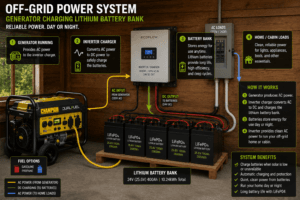
Charging Battery Banks
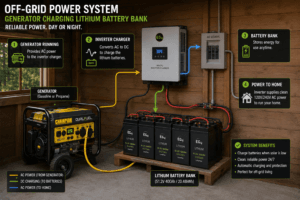
One of the most common generator uses in off-grid systems is charging battery banks.
Benefits include:
- Faster charging during cloudy weather
- Backup power during winter
- Reduced solar panel requirements
- Greater system reliability
Many off-grid homeowners only run their generator when battery levels become low, helping reduce fuel consumption while maintaining dependable power.
Which Generator Is Best?
Choose the Honda EU7000iS If:
- Quiet operation is important
- You want premium reliability
- Battery charging is your priority
- Fuel efficiency matters
Choose the DuroMax XP13000HXT If:
- You have a large off-grid home
- You operate heavy electrical loads
- Fuel flexibility is important
- Maximum power is your priority
Choose the Westinghouse iGen5000DFc If:
- You want quiet inverter power
- You charge battery banks regularly
- You use sensitive electronics
- Fuel efficiency is important
Choose the Champion 7500-Watt Dual Fuel Generator If:
- Budget is important
- You need dependable backup
- You want propane capability
- You’re building your first off-grid system
Choose the EcoFlow DELTA Pro 3 If:
- You already use solar panels
- Silent operation matters
- Indoor backup is important
- You want a hybrid energy system
Best Inverter Generator
Westinghouse iGen5000DFc

Why We Picked It
The Westinghouse iGen5000DFc is an excellent off-grid generator because it combines quiet inverter technology with the flexibility of dual-fuel operation. It produces clean electricity that’s ideal for charging battery banks, powering refrigerators, freezers, computers, lighting, and other sensitive electronics.
Its relatively quiet operation makes it especially well suited for cabins and remote properties where minimizing noise is important.
Pros
- Dual-fuel capability
- Quiet inverter operation
- Clean power for electronics
- Fuel efficient
- Electric start
- Long runtime
Cons
- Lower maximum output than large open-frame generators
- Higher purchase price than conventional generators
Best For
- Off-grid cabins
- Battery bank charging
- Solar backup systems
- Quiet operation
- Everyday power
Best Budget Generator
Champion 7500-Watt Dual Fuel Generator

Why We Picked It
The Champion 7500-Watt Dual Fuel Generator offers dependable backup power at an affordable price. It provides enough power for well pumps, refrigerators, freezers, lighting, power tools, and other household essentials while allowing operation on either gasoline or propane.
Its excellent value makes it a popular choice for first-time off-grid homeowners.
Pros
- Affordable
- Dual-fuel capability
- Electric start
- Reliable engine
- Excellent customer support
- Strong value
Cons
- Louder than inverter generators
- Less fuel efficient under lighter loads
Best For
- Budget-conscious buyers
- Homesteads
- Emergency backup
- Weekend cabins
Best Solar Companion
EcoFlow DELTA Pro 3 + Solar Panels

Why We Picked It
The EcoFlow DELTA Pro 3 works exceptionally well alongside an off-grid generator. During sunny weather, solar panels recharge the battery system, while the generator can provide supplemental charging during cloudy conditions or periods of high electrical demand.
This hybrid approach reduces fuel consumption while increasing overall energy independence.
Pros
- Silent operation
- Solar compatible
- Expandable battery capacity
- Fast charging
- Indoor operation
- Smart energy management
Cons
- Higher upfront investment
- Battery runtime depends on capacity and electrical load
Best For
- Solar-powered cabins
- Hybrid energy systems
- Quiet backup
- Remote homes
Generator Comparison
| Generator | Fuel Type | Inverter | Best For |
|---|---|---|---|
| Honda EU7000iS | Gasoline | ✔ | Best Overall |
| DuroMax XP13000HXT | Tri-Fuel | ✘ | Large Off-Grid Homes |
| Westinghouse iGen5000DFc | Dual Fuel | ✔ | Battery Charging |
| Champion 7500 Dual Fuel | Dual Fuel | ✘ | Best Budget |
| EcoFlow DELTA Pro 3 | Battery + Solar | N/A | Hybrid Systems |
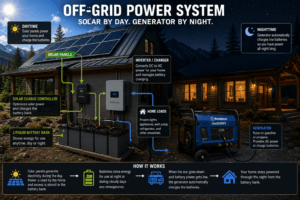
A hybrid system that combines solar panels, battery storage, and a generator can provide excellent reliability for off-grid living while reducing fuel consumption over time.
Fuel Options for Off-Grid Living
Gasoline
Advantages:
- Widely available
- High energy output
- Easy to transport
Disadvantages:
- Limited shelf life
- Requires fuel stabilizer
- Must be rotated regularly
Propane
Advantages:
- Long shelf life
- Cleaner burning
- Excellent emergency storage
- Lower maintenance
Disadvantages:
- Slightly lower power output
- Requires propane tanks
Natural Gas
Advantages:
- Continuous fuel supply
- No refueling required
- Excellent for properties with natural gas service
Disadvantages:
- Not available at most remote off-grid locations
Charging Battery Banks
One of the most common generator uses in off-grid systems is charging battery banks.
Benefits include:
- Faster charging during cloudy weather
- Backup power during winter
- Reduced solar panel requirements
- Greater system reliability
Many off-grid homeowners only run their generator when battery levels become low, helping reduce fuel consumption while maintaining dependable power.
Which Generator Is Best?
Choose the Honda EU7000iS If:
- Quiet operation is important
- You want premium reliability
- Battery charging is your priority
- Fuel efficiency matters
Choose the DuroMax XP13000HXT If:
- You have a large off-grid home
- You operate heavy electrical loads
- Fuel flexibility is important
- Maximum power is your priority
Choose the Westinghouse iGen5000DFc If:
- You want quiet inverter power
- You charge battery banks regularly
- You use sensitive electronics
- Fuel efficiency is important
Choose the Champion 7500-Watt Dual Fuel Generator If:
- Budget is important
- You need dependable backup
- You want propane capability
- You’re building your first off-grid system
Choose the EcoFlow DELTA Pro 3 If:
- You already use solar panels
- Silent operation matters
- Indoor backup is important
- You want a hybrid energy system
Features to Look For
Living off the grid places unique demands on a generator. Unlike emergency backup generators that may only operate a few days each year, off-grid generators often become a regular part of an independent power system.
Here are the most important features to compare before purchasing an off-grid generator.
Inverter Technology
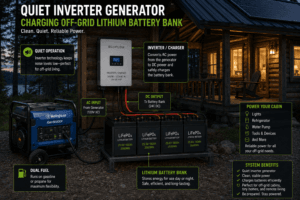
One of the best features for off-grid living is inverter technology.
Benefits include:
- Clean electricity
- Quiet operation
- Better fuel efficiency
- Stable voltage
- Safe for sensitive electronics
Inverter generators are ideal for powering:
- Computers
- Internet equipment
- Refrigerators
- Freezers
- LED lighting
- Battery chargers
- Medical equipment
If your generator will regularly charge batteries or power electronics, an inverter model is often the best choice.
Dual-Fuel or Tri-Fuel Capability
Fuel flexibility becomes extremely valuable at remote properties.
Dual-Fuel Generators
Operate on:
- Gasoline
- Propane
Tri-Fuel Generators
Operate on:
- Gasoline
- Propane
- Natural gas (where available)
Benefits include:
- Better emergency preparedness
- Longer fuel storage
- Greater flexibility
- Reduced dependence on a single fuel source
Propane is especially popular for off-grid living because it stores safely for long periods without degrading.
Long Runtime
Generators used off-grid often operate for several hours while charging battery banks.
Compare:
- Fuel tank size
- Runtime at 25% load
- Runtime at 50% load
Longer runtime reduces refueling frequency and improves convenience.
Electric Start
Electric start becomes increasingly valuable for generators that operate frequently.
Benefits include:
- Push-button starting
- Faster operation
- Less physical effort
- Easier cold-weather starts
Many premium off-grid generators include electric start as standard equipment.
Parallel Capability
Many inverter generators allow two identical units to be connected together.
Benefits include:
- Higher total output
- Improved portability
- Easier future expansion
- Better fuel efficiency under lighter loads
Some off-grid homeowners prefer two smaller inverter generators instead of one larger generator.
Low Total Harmonic Distortion (THD)
Clean electrical power is important for:
- Solar charge controllers
- Inverter chargers
- Computers
- Televisions
- Medical equipment
- Modern appliances
Lower THD provides cleaner electricity and helps protect sensitive electronics.
Fuel Efficiency
Generators used regularly should minimize fuel consumption.
Look for:
- Eco Mode
- Variable engine speed
- Inverter technology
- Long runtime
Lower fuel consumption reduces operating costs throughout the year.
Carbon Monoxide (CO) Shutdown
Modern generators often include carbon monoxide monitoring.
If unsafe CO levels are detected around the generator, the engine automatically shuts down.
Always operate portable generators outdoors in a well-ventilated area. Never run a generator inside a cabin, garage, shed, basement, or enclosed structure. Position it well away from doors, windows, and vents.
Common Buying Mistakes
Avoid these common mistakes when building an off-grid power system.
Buying Too Large
Many new off-grid homeowners purchase generators that are much larger than necessary.
Oversized generators:
- Consume more fuel
- Cost more
- Often operate less efficiently under light loads
Proper sizing saves money over time.
Buying Too Small
On the other hand, undersized generators may struggle to operate:
- Well pumps
- Air compressors
- Large refrigerators
- Power tools
- Battery chargers
Always calculate:
- Running watts
- Starting watts
- Future electrical needs
Ignoring Battery Charging
Many generators spend much of their time charging battery banks.
Look for generators that work efficiently with:
- Inverter chargers
- Lithium batteries
- Solar systems
- Hybrid energy systems
Poor Fuel Storage Planning
Off-grid living often requires storing fuel.
Gasoline:
- Requires stabilizer
- Must be rotated
- Has limited shelf life
Propane:
- Stores for years
- Burns cleaner
- Requires little maintenance
Proper fuel planning improves long-term reliability.
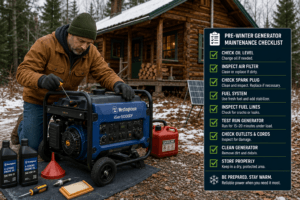
Skipping Maintenance
Routine maintenance keeps generators dependable.
Regularly:
- Change engine oil
- Replace air filters
- Inspect spark plugs
- Exercise the generator
- Check battery condition
- Inspect fuel lines
Routine maintenance greatly extends engine life.
Frequently Asked Questions
What is the best generator for off-grid living?
For many off-grid homeowners, the Honda EU7000iS offers an excellent combination of reliability, fuel efficiency, quiet operation, and clean inverter power.
Larger off-grid homes may benefit from the additional output of the DuroMax XP13000HXT.
Can I live completely off-grid with only a generator?
Technically yes, but most off-grid homeowners combine:
- Solar panels
- Battery storage
- Generator backup
This hybrid approach reduces fuel costs while providing dependable electricity year-round.
Is propane better than gasoline?
Many off-grid homeowners prefer propane because:
- It stores for years
- Burns cleaner
- Requires less maintenance
- Doesn’t require fuel stabilizer
Gasoline remains widely available and offers excellent power output but requires more careful storage.
Can generators charge lithium battery banks?
Yes.
Many generators work well with inverter chargers designed for modern lithium battery systems. Always verify compatibility with your specific charger and battery bank.
Are inverter generators worth the extra cost?
For most off-grid applications, yes.
Benefits include:
- Quiet operation
- Better fuel economy
- Cleaner electricity
- Longer engine life
- Reduced fuel consumption
How often should I maintain my off-grid generator?
Follow the manufacturer’s maintenance schedule, but if your generator is used regularly, inspect it frequently and perform oil changes, air filter service, and spark plug replacement as recommended. Heavy off-grid use generally requires more maintenance than occasional emergency backup use.
Final Thoughts
Reliable electricity is one of the foundations of successful off-grid living, and a quality generator remains an important part of almost every independent power system. While solar panels and battery storage can provide most of your daily energy, a dependable generator helps recharge batteries during cloudy weather, operate heavy electrical loads, and provide backup power when renewable energy alone isn’t enough.
For most off-grid homeowners, the Honda EU7000iS remains one of the best all-around choices thanks to its exceptional reliability, quiet inverter technology, and excellent fuel efficiency. If your property has larger electrical demands, the DuroMax XP13000HXT Tri-Fuel Generator offers outstanding power and fuel flexibility. The Westinghouse iGen5000DFc is an excellent choice for efficient battery charging, while the Champion 7500-Watt Dual Fuel Generator provides exceptional value for those building an off-grid system on a budget. Homeowners using solar energy should also consider pairing their system with the EcoFlow DELTA Pro 3 to create a flexible hybrid backup solution.
Before investing in an off-grid generator, calculate your daily energy consumption, evaluate your battery storage capacity, and choose a generator that complements your renewable energy system. The right combination of solar panels, batteries, and generator backup can provide dependable, year-round power while reducing fuel costs and increasing your energy independence.