
Power outages are becoming increasingly common due to severe storms, hurricanes, winter weather, wildfires, and aging electrical infrastructure. While traditional portable and standby generators remain popular, portable power stations have quickly become one of the best backup power solutions for homeowners who want quiet, emission-free electricity without storing gasoline or performing engine maintenance.
Modern portable power stations use long-lasting LiFePO₄ (Lithium Iron Phosphate) batteries and can power refrigerators, freezers, routers, CPAP machines, televisions, laptops, lights, and many other essential household devices. Many also support solar charging, fast AC charging, expandable battery capacity, app control, and UPS (uninterruptible power supply) functionality, making them excellent choices for emergency home backup. Recent testing continues to rank models from EcoFlow, Anker, Bluetti, and Jackery among the top performers for home backup use.
In this guide, we’ll compare the best portable power stations for home backup in 2026, explain what features matter most, and help you choose the right battery backup system for your home.
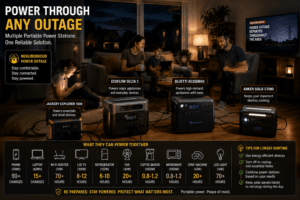
Quick Picks: Best Portable Power Stations for Home Backup
| Category | Portable Power Station | Best For |
|---|---|---|
| Best Overall | EcoFlow DELTA Pro 3 | Whole-home backup and expandability |
| Best High-Capacity | Anker SOLIX F3800 | Large homes and heavy appliances |
| Best Value | Jackery Explorer 2000 Plus | Reliable emergency backup |
| Best Budget | Bluetti AC180 | Affordable home backup |
| Best Expandable | Bluetti AC500 + B300K Batteries | Long-duration backup |
Why Choose a Portable Power Station?
Unlike gasoline-powered generators, portable power stations store electricity inside rechargeable batteries.
Benefits include:
- Silent operation
- Indoor safe operation
- No gasoline or propane
- No engine maintenance
- No exhaust fumes
- Instant startup
- Solar charging capability
- Safe power for electronics
For many homeowners, they’re an excellent solution for short- and medium-length power outages.
Best Overall
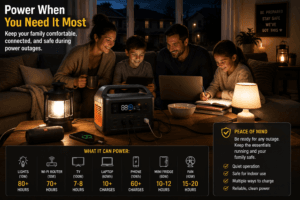
EcoFlow DELTA Pro 3
[IMAGE PLACEHOLDER – EcoFlow DELTA Pro 3 Portable Power Station]
Why We Picked It
The EcoFlow DELTA Pro 3 is one of the most capable portable power stations currently available. It combines a large battery, powerful AC inverter, rapid charging, expandable capacity, UPS functionality, and app-based monitoring into a single system.
It can power refrigerators, freezers, internet equipment, televisions, medical devices, lights, microwave ovens, and many additional household appliances during an outage.
Pros
- Large battery capacity
- Expandable system
- Fast charging
- UPS functionality
- Solar compatible
- Smart app control
- Quiet operation
Cons
- Premium price
- Heavy compared to smaller units
Best For
- Home backup
- Extended outages
- Solar-powered homes
- Emergency preparedness
Best High-Capacity Power Station
Anker SOLIX F3800

Why We Picked It
The Anker SOLIX F3800 is designed for homeowners with higher electrical demands. It delivers exceptional output, supports expansion batteries, and can power many large household appliances that smaller power stations cannot.
It is capable of supporting refrigerators, freezers, lighting, medical equipment, internet systems, and many other essential circuits. It is also designed with home backup applications in mind and can integrate into larger backup systems.
Pros
- Extremely high output
- Expandable battery system
- Whole-home backup potential
- Fast charging
- App monitoring
- Solar compatible
Cons
- Expensive
- Heavy
Best For
- Large homes
- Heavy electrical loads
- Long outages
- Whole-home backup
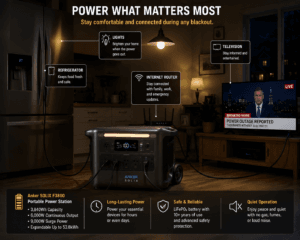
Choosing the Right Portable Power Station
Before purchasing a portable power station, consider:
- Battery capacity (Wh)
- Continuous output (W)
- Surge output
- Expandability
- UPS capability
- Solar charging support
- Charging speed
- Weight
- Number of AC outlets
- Future power needs
Selecting the right portable power station today can provide years of dependable emergency backup power without the maintenance required by traditional generators.
Best Value Portable Power Station
Jackery Explorer 2000 Plus

Why We Picked It
The Jackery Explorer 2000 Plus offers an outstanding balance of capacity, performance, portability, and expandability. It delivers enough power to run refrigerators, freezers, televisions, routers, CPAP machines, lights, and many kitchen appliances while supporting additional expansion batteries for longer outages.
Its LiFePO₄ battery, fast charging, and quiet operation make it one of the best values for emergency home backup.
Pros
- Excellent value
- Expandable battery capacity
- Fast AC charging
- LiFePO₄ battery
- Solar compatible
- Quiet operation
Cons
- Heavy
- Premium price compared to entry-level models
Best For
- Home backup
- Emergency preparedness
- Medium-sized homes
- RV owners
Best Budget Portable Power Station
Bluetti AC180

Why We Picked It
The Bluetti AC180 is one of the best affordable portable power stations available. It offers enough capacity to power refrigerators, lighting, internet equipment, televisions, laptops, and many small household appliances while remaining relatively compact and easy to transport.
Its fast charging and pure sine wave inverter make it an excellent choice for first-time buyers looking for dependable emergency backup.
Pros
- Affordable
- Fast charging
- Pure sine wave inverter
- LiFePO₄ battery
- Compact design
- Quiet operation
Cons
- Lower capacity than premium models
- Limited runtime for larger appliances
Best For
- Apartments
- Small homes
- Emergency backup
- First-time buyers
Best Expandable Battery System
Bluetti AC500 + B300K Expansion Batteries

Why We Picked It
The Bluetti AC500 paired with B300K expansion batteries provides one of the most expandable portable home backup systems available. Homeowners can increase storage capacity significantly while maintaining clean, quiet operation.
It’s capable of powering refrigerators, freezers, lighting, communications equipment, medical devices, and many larger household loads when properly configured.
Pros
- Massive expandable capacity
- Powerful inverter
- Solar compatible
- Long battery life
- Smart app monitoring
- Quiet operation
Cons
- Expensive when fully expanded
- Requires additional batteries for maximum capacity
Best For
- Large homes
- Extended outages
- Solar-powered homes
- Whole-home backup projects
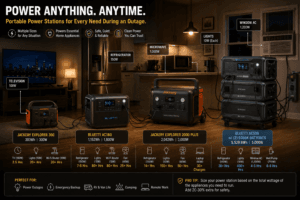
Portable Power Station Comparison
| Portable Power Station | Battery Type | Expandable | Best For |
|---|---|---|---|
| EcoFlow DELTA Pro 3 | LiFePO₄ | ✔ | Best Overall |
| Anker SOLIX F3800 | LiFePO₄ | ✔ | Large Homes |
| Jackery Explorer 2000 Plus | LiFePO₄ | ✔ | Best Value |
| Bluetti AC180 | LiFePO₄ | Limited | Budget Backup |
| Bluetti AC500 + B300K | LiFePO₄ | ✔ | Maximum Capacity |
Modern LiFePO₄ power stations provide longer battery life, faster charging, and safer operation than older lithium-ion designs, making them excellent choices for home backup.
Understanding Battery Capacity
Battery capacity is measured in watt-hours (Wh).
General guidelines:
- 500–1,000Wh — Phones, laptops, lights, routers
- 1,000–2,000Wh — Refrigerators, CPAP machines, televisions
- 2,000–4,000Wh — Multiple appliances
- 4,000Wh+ — Larger home backup systems
Remember that actual runtime depends on how much power your connected devices consume.
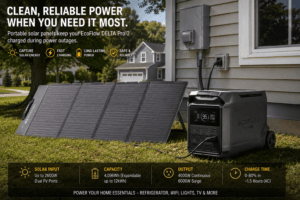
Solar Charging Options
Most premium portable power stations now support solar charging.
Benefits include:
- Renewable energy
- Lower operating costs
- Extended runtime during outages
- Greater energy independence
- Excellent for off-grid use
Solar charging is especially valuable during prolonged outages when grid electricity isn’t available.
Which Portable Power Station Is Best?
Choose the EcoFlow DELTA Pro 3 If:
- You want the best overall performance
- Expandability is important
- You need serious home backup
- Fast charging matters
Choose the Anker SOLIX F3800 If:
- You have a large home
- You need higher power output
- Whole-home backup is your goal
- Heavy appliances are a priority
Choose the Jackery Explorer 2000 Plus If:
- You want excellent overall value
- Expandability matters
- Quiet operation is important
- You need dependable emergency backup
Choose the Bluetti AC180 If:
- Budget is your top priority
- You have a smaller home
- You want a compact backup solution
- You need reliable emergency power
Choose the Bluetti AC500 If:
- You want maximum battery capacity
- You already have solar panels
- Long outages are common
- You plan to expand your system over time
Features to Look For
Portable power stations have evolved rapidly over the past few years. Today’s premium models offer features that make them excellent alternatives—or companions—to traditional generators for emergency home backup.
Before purchasing a portable power station, compare these important features.
LiFePO₄ Battery Technology
Most premium portable power stations now use Lithium Iron Phosphate (LiFePO₄) batteries.
Benefits include:
- Longer battery lifespan
- Improved safety
- Better thermal stability
- Thousands of charge cycles
- Lower long-term ownership costs
LiFePO₄ batteries typically last significantly longer than older lithium-ion battery chemistries.
Battery Capacity
Battery capacity determines how long your devices can operate.
General recommendations:
- 500–1,000Wh — Phones, laptops, lighting
- 1,000–2,000Wh — Refrigerators, CPAP machines, televisions
- 2,000–4,000Wh — Multiple household appliances
- 4,000Wh+ — Extended home backup
Larger battery capacity generally means longer runtime during power outages.
Pure Sine Wave Inverter
Always choose a portable power station with a pure sine wave inverter.
Benefits include:
- Safe for sensitive electronics
- Stable voltage output
- Reduced equipment wear
- Better appliance compatibility
Pure sine wave output is recommended for:
- Computers
- Medical equipment
- Gaming consoles
- Televisions
- Refrigerators
- Internet equipment
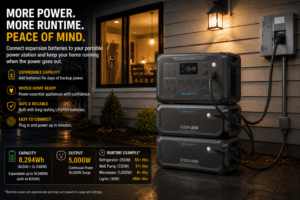
Expandable Battery Capacity
Many premium systems allow additional batteries.
Benefits include:
- Longer runtime
- Future expansion
- Greater flexibility
- Better long-term value
Expandable systems are ideal for homeowners planning to increase their backup power over time.
Solar Charging
One of the biggest advantages of portable power stations is solar charging.
Benefits include:
- Renewable energy
- Lower operating costs
- Silent charging
- Unlimited daytime charging potential (weather permitting)
- Excellent for extended outages
Solar charging is especially valuable during prolonged power outages.
Fast Charging
Charging speed varies greatly between models.
Some premium power stations can recharge from low battery to near full in approximately one to two hours using AC power under favorable conditions.
Fast charging provides:
- Less downtime
- Greater convenience
- Better emergency readiness
UPS (Uninterruptible Power Supply)
Many premium power stations now include UPS functionality.
Benefits include:
- Automatic switchover
- Continuous power for electronics
- Protection for computers
- Internet equipment remains online
- Ideal for home offices
Smart App Monitoring
Many models include smartphone apps.
Features often include:
- Battery percentage
- Power usage
- Charging status
- Solar input
- Remote controls
- Firmware updates
App monitoring makes managing your backup system much easier.
Number of AC Outlets
Consider how many devices you’ll operate simultaneously.
Some power stations include:
- Multiple AC outlets
- USB-C ports
- USB-A ports
- 12V vehicle outlets
- DC outputs
More output options provide greater flexibility during emergencies.
Common Buying Mistakes
Avoid these common mistakes when purchasing a portable power station.
Buying Too Small
Many homeowners underestimate how much battery capacity they need.
Always consider:
- Refrigerator runtime
- Freezer runtime
- Internet equipment
- Medical devices
- Lighting
- Future electrical needs
Buying slightly more capacity often provides better long-term value.
Ignoring Surge Power
Some appliances require significantly more power during startup.
Examples include:
- Refrigerators
- Freezers
- Sump pumps
- Power tools
Always compare both:
- Continuous output
- Surge output
Forgetting Solar Compatibility
If you may eventually add solar panels, choose a model that already supports solar charging.
Doing so allows:
- Easier expansion
- Greater emergency preparedness
- Reduced fuel dependence
- Lower long-term operating costs
Overlooking Weight
Large portable power stations often weigh well over 80 pounds.
If portability is important:
Consider:
- Built-in wheels
- Extendable handles
- Carry handles
- Overall dimensions
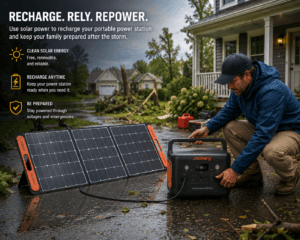
Not Planning for Long Outages
Battery systems eventually require recharging.
For extended outages, consider:
- Expansion batteries
- Solar panels
- A backup portable generator
- Hybrid systems
Many homeowners combine a portable power station with a generator for maximum flexibility.
Frequently Asked Questions
Can a portable power station power a refrigerator?
Yes.
Many portable power stations with sufficient battery capacity and inverter output can operate refrigerators for several hours or longer, depending on refrigerator size, efficiency, and how often the door is opened.
Can portable power stations power an entire house?
Some high-capacity expandable systems can power many household circuits.
However, most portable power stations are intended to operate:
- Refrigerators
- Freezers
- Lights
- Internet equipment
- Medical devices
- Televisions
- Small kitchen appliances
Whole-home backup generally requires either a very large expandable battery system or a standby generator.
Are portable power stations safe indoors?
Yes.
Unlike gasoline generators, battery-powered portable power stations produce no carbon monoxide during operation and are designed for indoor use.
Always follow the manufacturer’s instructions regarding ventilation, charging, and operating temperature.
How long do portable power stations last?
Most modern LiFePO₄ power stations are rated for thousands of charge cycles before battery capacity noticeably declines. Actual lifespan depends on usage, charging habits, storage conditions, and manufacturer specifications.
Are portable power stations better than generators?
It depends on your needs.
Portable power stations offer:
- Silent operation
- Indoor safety
- No fuel
- Very little maintenance
Traditional generators offer:
- Higher continuous power
- Longer runtime with refueling
- Better support for heavy electrical loads
Many homeowners use both for complete emergency preparedness.
Can I recharge a portable power station with solar panels?
Yes.
Most premium models support compatible solar panels, allowing you to recharge the battery during daylight hours. Charging speed depends on solar panel size, weather conditions, and available sunlight.
Final Thoughts
Portable power stations have become one of the best home backup solutions for homeowners who want quiet, clean, and maintenance-free emergency power. They eliminate the need for gasoline, produce no exhaust emissions during operation, and can safely power many essential household devices indoors.
For most homeowners, the EcoFlow DELTA Pro 3 remains one of the best overall choices thanks to its large battery capacity, expandability, fast charging, and powerful inverter. Those with larger homes and higher electrical demands should consider the Anker SOLIX F3800, while the Jackery Explorer 2000 Plus delivers outstanding value with expandable storage and dependable performance. Budget-conscious buyers will appreciate the Bluetti AC180, and homeowners planning a large battery backup system should take a close look at the expandable Bluetti AC500 with B300K batteries.
Before making your purchase, calculate the wattage of the appliances you want to power, determine how long you need backup electricity, and consider future expansion with additional batteries or solar panels. Choosing the right portable power station today can provide years of dependable backup power and greater peace of mind when the next outage occurs.