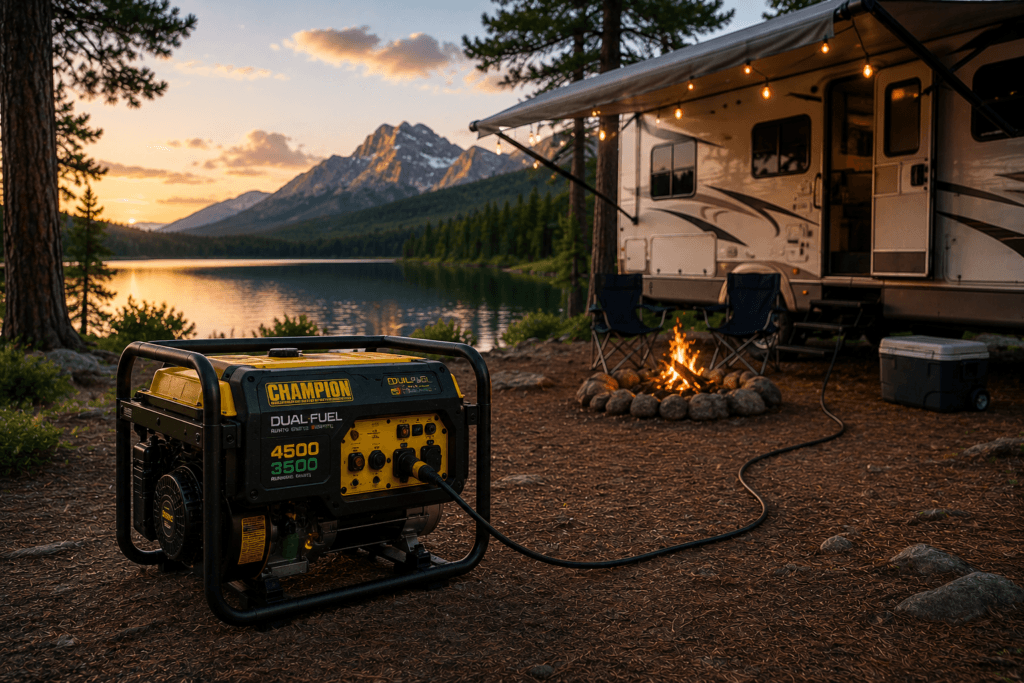
Power outages caused by severe storms, hurricanes, winter weather, wildfires, and aging electrical infrastructure have made home backup power more important than ever. While traditional gasoline generators remain popular, many homeowners are turning to solar generators as a cleaner, quieter, and lower-maintenance alternative.
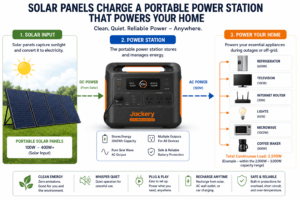
A solar generator combines a portable power station with one or more solar panels, allowing you to store electricity in a rechargeable battery and recharge it using sunlight. Unlike gas generators, solar generators produce no exhaust emissions during operation, require very little maintenance, and are safe to operate indoors because they do not produce carbon monoxide. Modern systems also feature LiFePO₄ batteries, expandable battery capacity, fast charging, UPS functionality, app control, and high-powered inverters, making them increasingly capable of supporting home backup needs. Recent testing continues to rank models from EcoFlow, Anker, Jackery, and Bluetti among the top performers for emergency home backup.
In this guide, we’ll compare the best solar generators for home backup in 2026, explain which features matter most, and help you choose the right solar-powered backup system for your home.
Quick Picks: Best Solar Generators for Home Backup
| Category | Solar Generator | Best For |
|---|---|---|
| Best Overall | EcoFlow DELTA Pro 3 + Solar Panels | Whole-home backup |
| Best High-Capacity | Anker SOLIX F3800 + Solar Panels | Large homes |
| Best Value | Jackery Explorer 2000 Plus + Solar Panels | Reliable emergency backup |
| Best Budget | Bluetti AC180 + Solar Panels | Affordable home backup |
| Best Expandable | Bluetti AC500 + B300K Batteries + Solar Panels | Long-duration outages |
What Is a Solar Generator?
A solar generator combines two primary components:
- Portable power station
- Solar panels
The solar panels collect sunlight and convert it into electricity, while the battery stores that energy for later use.
Unlike gasoline generators, solar generators:
- Produce no engine noise
- Require no fuel
- Produce no exhaust emissions during operation
- Require minimal maintenance
- Can safely operate indoors
Most systems can also recharge from a standard wall outlet when utility power is available.
Best Overall
EcoFlow DELTA Pro 3 + Solar Panels

Why We Picked It
The EcoFlow DELTA Pro 3 is one of the most capable solar generators currently available. It combines a powerful inverter, large LiFePO₄ battery, rapid charging, expandable battery capacity, and high solar input to create an excellent home backup system.
It can power refrigerators, freezers, lighting, internet equipment, medical devices, televisions, microwaves, and many additional household appliances. With optional expansion batteries, the system can grow substantially to support longer outages.
Pros
- Massive battery capacity
- Expandable system
- Fast charging
- UPS functionality
- Excellent solar charging capability
- Smart app monitoring
- Quiet operation
Cons
- Premium purchase price
- Heavy
Best For
- Home backup
- Extended outages
- Solar-powered homes
- Whole-home energy systems
Best High-Capacity Solar Generator
Anker SOLIX F3800 + Solar Panels
check online Anker SOLIX F3800 Portable Power Station with Solar Panels]
check online check online Anker SOLIX F3800 Portable Power Station with Solar Panels]
Why We Picked It
The Anker SOLIX F3800 delivers exceptional output for homeowners with higher electrical demands. It supports expansion batteries, high solar input, and can power many larger household appliances that smaller solar generators cannot.
It’s well suited for refrigerators, freezers, lighting, home offices, medical devices, and many essential household circuits during outages.
Pros
- Very high power output
- Expandable battery system
- Solar compatible
- Fast charging
- App monitoring
- Long battery life
Cons
- Expensive
- Heavy
Best For
- Large homes
- Long outages
- Heavy electrical loads
- Whole-home backup projects
[IMAGE PLACEHOLDER – Solar generator powering a refrigerator, internet router, lights, and television during a neighborhood blackout.]
Choosing the Right Solar Generator
Before purchasing a solar generator, consider:
- Battery capacity (Wh)
- Continuous output (W)
- Surge output
- Solar charging input
- Expandability
- UPS capability
- Charging speed
- Weight
- Number of AC outlets
- Future energy needs
Choosing the right solar generator today can provide dependable backup power for years while reducing dependence on gasoline and offering renewable energy during extended outages.
Best Value Solar Generator
Jackery Explorer 2000 Plus + Solar Panels

Why We Picked It
The Jackery Explorer 2000 Plus delivers an excellent balance of battery capacity, portability, expandability, and ease of use. It features a long-lasting LiFePO₄ battery, a powerful pure sine wave inverter, and support for expansion batteries, making it a dependable choice for emergency home backup.
When paired with Jackery SolarSaga panels, it can recharge using sunlight during extended outages while powering refrigerators, freezers, internet equipment, lights, CPAP machines, and many other essential devices. It also supports expansion up to much larger battery capacities for homeowners who need longer runtimes.
Pros
- Excellent overall value
- Expandable battery system
- Fast AC charging
- LiFePO₄ battery
- Solar compatible
- Quiet operation
Cons
- Heavy
- Premium price compared to entry-level units
Best For
- Home backup
- Emergency preparedness
- Medium-sized homes
- Off-grid use
Best Budget Solar Generator
Bluetti AC180 + Solar Panels

Why We Picked It
The Bluetti AC180 provides dependable emergency backup without the higher cost of larger systems. It offers enough power for refrigerators, internet equipment, televisions, lighting, laptops, medical devices, and many small household appliances.
Its compact size, LiFePO₄ battery, and fast charging make it one of the best affordable solar generator options for homeowners.
Pros
- Affordable
- Fast charging
- Pure sine wave inverter
- LiFePO₄ battery
- Compact design
- Quiet operation
Cons
- Lower battery capacity
- Limited runtime for larger appliances
Best For
- Apartments
- Small homes
- Emergency backup
- First-time buyers
Best Expandable Solar Generator
Bluetti AC500 + B300K Batteries + Solar Panels

Why We Picked It
The Bluetti AC500 paired with B300K expansion batteries offers one of the most expandable home backup systems available. Homeowners can significantly increase battery capacity while maintaining quiet, emission-free operation.
Its powerful inverter and high solar charging capability make it suitable for refrigerators, freezers, lighting, communications equipment, medical devices, and many larger household loads.
Pros
- Massive expandable capacity
- Powerful inverter
- Excellent solar charging
- Long battery lifespan
- Smart app monitoring
- Quiet operation
Cons
- Expensive when fully expanded
- Requires additional batteries for maximum capacity
Best For
- Large homes
- Multi-day outages
- Solar-powered homes
- Whole-home battery backup
Solar Generator Comparison
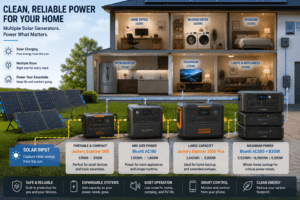
| Solar Generator | Battery Type | Expandable | Best For |
|---|---|---|---|
| EcoFlow DELTA Pro 3 | LiFePO₄ | ✔ | Best Overall |
| Anker SOLIX F3800 | LiFePO₄ | ✔ | Large Homes |
| Jackery Explorer 2000 Plus | LiFePO₄ | ✔ | Best Value |
| Bluetti AC180 | LiFePO₄ | Limited | Budget Backup |
| Bluetti AC500 + B300K | LiFePO₄ | ✔ | Maximum Capacity |
Modern LiFePO₄ solar generators provide longer battery life, improved safety, and excellent emergency backup performance compared to older battery technologies.
Understanding Battery Capacity
Battery capacity is measured in watt-hours (Wh).
General recommendations:
- 500–1,000Wh — Phones, tablets, lights, routers
- 1,000–2,000Wh — Refrigerators, CPAP machines, televisions
- 2,000–4,000Wh — Multiple household appliances
- 4,000Wh+ — Serious home backup systems
Actual runtime depends on how much electricity your connected appliances consume.
Solar Charging Options
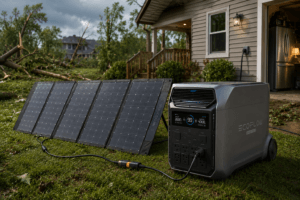
Solar charging allows homeowners to recharge batteries without utility power.
Benefits include:
- Renewable energy
- Quiet charging
- Lower operating costs
- Unlimited daytime charging potential (weather permitting)
- Greater energy independence
- Excellent for extended outages
Higher solar input ratings generally reduce recharge times under favorable sunlight conditions.
Which Solar Generator Is Best?
Choose the EcoFlow DELTA Pro 3 If:
- You want the best overall system
- Expandability is important
- You need serious home backup
- Fast charging matters
Choose the Anker SOLIX F3800 If:
- You have a large home
- You need higher power output
- Whole-home backup is your goal
- Heavy appliances are a priority
Choose the Jackery Explorer 2000 Plus If:
- You want outstanding overall value
- Expandability matters
- Quiet operation is important
- You need dependable emergency backup
Choose the Bluetti AC180 If:
- Budget is your priority
- You have a smaller home
- You want a compact backup solution
- You need reliable emergency power
Choose the Bluetti AC500 If:
- You want maximum battery capacity
- You already own solar panels
- Long outages are common
- You plan to expand your system over time
Features to Look For
Modern solar generators have become significantly more powerful over the past few years. Today’s premium systems can provide quiet, emission-free backup power for many household appliances while requiring very little maintenance.
Before purchasing a solar generator, compare these important features.
LiFePO₄ Battery Technology
The best solar generators now use Lithium Iron Phosphate (LiFePO₄) batteries.
Benefits include:
- Longer battery lifespan
- Greater safety
- Better heat resistance
- Thousands of charge cycles
- Lower long-term ownership costs
LiFePO₄ batteries generally last much longer than older lithium-ion battery technologies.
Battery Capacity
Battery capacity determines how long your appliances can operate.
General guidelines:
- 500–1,000Wh — Phones, tablets, lights
- 1,000–2,000Wh — Refrigerators, CPAP machines, televisions
- 2,000–4,000Wh — Multiple household appliances
- 4,000Wh+ — Large home backup systems
Larger batteries provide longer runtime during power outages.
Pure Sine Wave Inverter
Always choose a solar generator with a pure sine wave inverter.
Benefits include:
- Safe power for electronics
- Stable voltage
- Reduced equipment wear
- Better appliance compatibility
Pure sine wave power is recommended for:
- Computers
- Televisions
- Medical equipment
- Refrigerators
- Freezers
- Internet equipment
- Home office electronics
Solar Input Capacity
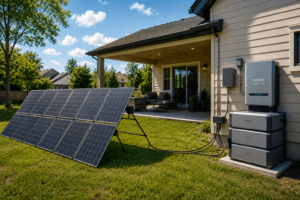
One of the biggest differences between solar generators is the amount of solar charging they support.
Higher solar input allows:
- Faster charging
- Better performance during extended outages
- Greater renewable energy production
- Reduced dependence on grid charging
If you plan to rely heavily on solar charging, compare maximum solar input specifications carefully.
Expandable Battery Capacity
Many premium systems support expansion batteries.
Benefits include:
- Longer runtime
- More backup capacity
- Future system upgrades
- Better long-term value
Expandable systems are ideal for homeowners expecting future energy needs to increase.
UPS (Uninterruptible Power Supply)
Many premium solar generators now include UPS functionality.
Benefits include:
- Automatic switchover during outages
- Protection for computers
- Continuous internet service
- Ideal for home offices
- Reduced interruption for sensitive electronics
Fast Charging
Charging speed varies between manufacturers.
Many premium models can recharge rapidly using:
- Wall outlets
- Solar panels
- Compatible generators
Fast charging reduces downtime between power outages.
Smart App Monitoring
Many solar generators include smartphone apps.
Features often include:
- Battery percentage
- Power usage
- Solar input
- Charging status
- Remote controls
- Firmware updates
App monitoring simplifies system management.
Multiple Output Options
Modern solar generators often include:
- AC outlets
- USB-C ports
- USB-A ports
- 12V DC outputs
- Anderson ports (on some models)
More output options allow greater flexibility during emergencies.
Common Buying Mistakes
Avoid these common mistakes before purchasing a solar generator.
Buying Too Small
Many homeowners underestimate their electrical needs.
Include:
- Refrigerators
- Freezers
- Internet equipment
- Medical devices
- Lighting
- Home office equipment
- Future appliances
Buying slightly more battery capacity often provides better long-term value.
Ignoring Solar Charging Speed
Not all solar generators recharge equally.
Compare:
- Maximum solar input
- Recommended solar panel size
- Expansion capability
Higher solar input allows faster battery recovery during extended outages.
Forgetting Expandability
Many homeowners eventually want additional battery storage.
Choosing an expandable system today can save money later by allowing future upgrades instead of replacing the entire unit.
Expecting Unlimited Runtime
Even large solar generators eventually require recharging.
For very long outages, consider:
- Additional solar panels
- Expansion batteries
- A backup portable generator
- A hybrid backup system
Many homeowners combine solar generators with fuel-powered generators for maximum reliability.
Skipping Battery Maintenance Guidelines
Although solar generators require far less maintenance than gasoline generators, proper care still matters.
Follow manufacturer recommendations regarding:
- Storage temperature
- Charging intervals
- Battery maintenance
- Firmware updates
- Long-term storage
Proper care helps maximize battery lifespan.
Frequently Asked Questions
What is a solar generator?
A solar generator combines:
- Portable power station
- Rechargeable battery
- Solar panels
The battery stores electricity while the solar panels recharge it using sunlight.
Can a solar generator power a refrigerator?
Yes.
Many solar generators with sufficient battery capacity and inverter output can power refrigerators for several hours or longer, depending on refrigerator size, efficiency, and usage.
Can a solar generator power an entire house?
Some expandable systems can power many household circuits.
However, most portable solar generators are designed to operate essential appliances such as:
- Refrigerators
- Freezers
- Lights
- Internet equipment
- Medical devices
- Televisions
- Small kitchen appliances
Very large homes generally require larger battery systems or standby generators for complete whole-home backup.
Are solar generators safe indoors?
Yes.
Unlike gasoline generators, solar generators produce no carbon monoxide during operation and are designed for indoor use.
Always follow the manufacturer’s instructions regarding charging, ventilation around the unit, and operating temperature.
Do solar generators work during cloudy weather?
Yes, but charging speed is usually reduced because less sunlight reaches the solar panels.
Most homeowners recharge from wall outlets when available and use solar charging to extend runtime during longer outages.
Are solar generators better than gas generators?
Each has advantages.
Solar generators offer:
- Silent operation
- No fuel
- Minimal maintenance
- Indoor-safe operation
- Renewable charging
Gas generators offer:
- Higher continuous power
- Unlimited runtime with refueling
- Better support for heavy electrical loads
Many homeowners use both together for complete emergency preparedness.
Final Thoughts
Solar generators have become one of the most practical home backup solutions for homeowners who want quiet, clean, and maintenance-free emergency power. They eliminate the need to store gasoline, produce no exhaust emissions during operation, and can safely power many essential household appliances inside your home. When paired with solar panels, they also provide renewable energy that can help extend backup power during prolonged outages.
For most homeowners, the EcoFlow DELTA Pro 3 remains the best overall solar generator thanks to its exceptional battery capacity, fast charging, expandability, and powerful inverter. The Anker SOLIX F3800 is an excellent option for larger homes with higher electrical demands, while the Jackery Explorer 2000 Plus delivers outstanding value with expandable storage and dependable performance. Budget-conscious buyers should consider the Bluetti AC180, and homeowners planning a larger backup system will appreciate the expandability of the Bluetti AC500 with B300K batteries.
Before purchasing, calculate the wattage of the appliances you want to power, estimate how long you’ll need backup electricity, and consider whether expansion batteries or additional solar panels may be beneficial in the future. The right solar generator can provide years of dependable backup power while reducing your dependence on traditional fuel-powered generators.