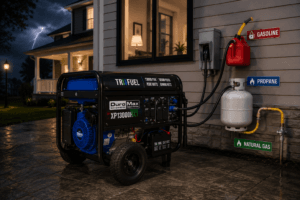
Power outages caused by hurricanes, tornadoes, winter storms, and aging electrical infrastructure can leave your home without electricity for hours or even days. While gasoline and dual-fuel generators remain popular, tri-fuel generators offer the greatest flexibility by allowing homeowners to operate on gasoline, propane, or natural gas.
This flexibility can make a significant difference during extended outages. If gasoline becomes difficult to find after a major storm, you can switch to propane. If your home has a natural gas connection, you may be able to operate continuously without refueling, depending on local gas service. Modern tri-fuel generators also include features such as electric start, remote start, CO shutdown systems, 120/240-volt output, transfer switch compatibility, and low total harmonic distortion (THD) on select models. Models from Champion, DuroMax, Westinghouse, and WEN are among the leading choices in today’s market.
Quick Picks: Best Tri-Fuel Generators for Home Backup
| Category | Generator | Best For |
|---|---|---|
| Best Overall | DuroMax XP13000HXT | Overall home backup |
| Best Inverter | Champion 9000-Watt Tri-Fuel Inverter Generator | Quiet home backup |
| Best High-Output | Westinghouse WGen11500TFc | Large homes |
| Best Budget | WEN TF1450X Tri-Fuel Generator | Affordable high output |
| Best Value | Firman T08073 Tri-Fuel Generator | Excellent all-around performance |
Why Choose a Tri-Fuel Generator?
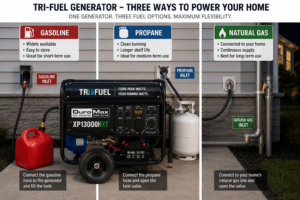
Tri-fuel generators provide unmatched flexibility during emergencies.
They can operate using:
- Gasoline
- Propane
- Natural gas
Benefits include:
- Multiple fuel options
- Easier emergency fueling
- Longer propane storage
- Unlimited runtime on natural gas (where available)
- Excellent emergency preparedness
- Reduced dependence on one fuel source
For homeowners who already have a natural gas connection, tri-fuel generators can eliminate the need to store large amounts of gasoline.
Best Overall
DuroMax XP13000HXT Tri-Fuel Generator
Why We Picked It
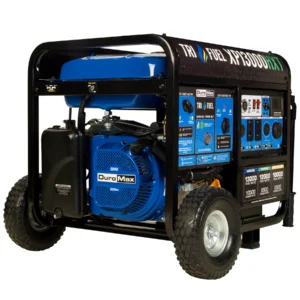
The DuroMax XP13000HXT remains one of the best portable tri-fuel generators available for home backup. It offers impressive surge capacity, true tri-fuel capability, electric start, and 120/240-volt output suitable for powering essential household circuits through a transfer switch.
Its ability to operate on natural gas, propane, or gasoline makes it especially attractive for homeowners preparing for long-duration outages.
Pros
- True tri-fuel capability
- Excellent starting wattage
- Electric start
- 120/240V output
- Transfer switch compatible
- Strong overall value
Cons
- Heavy
- Louder than enclosed inverter generators
Best For
- Home backup
- Rural homes
- Well pumps
- Large electrical loads
Best Tri-Fuel Inverter Generator
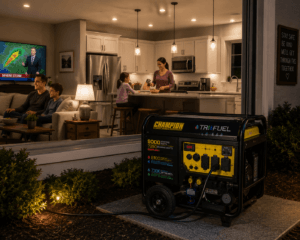
Champion 9000-Watt Tri-Fuel Inverter Generator

Why We Picked It
The Champion 9000-Watt Tri-Fuel Inverter Generator combines the flexibility of three fuel choices with the advantages of inverter technology. It produces cleaner electricity for sensitive electronics while operating noticeably quieter than traditional open-frame generators.
It includes electric start, Economy Mode, and hoses for propane and natural gas, making it ready for multiple fuel sources right out of the box.
Pros
- Tri-fuel capability
- Clean inverter power
- Quieter operation
- Electric start
- Economy Mode
- Safe for sensitive electronics
Cons
- Lower running watts on natural gas
- Premium price
Best For
- Home offices
- Electronics
- Quiet neighborhoods
- Medium-sized homes
 ]
]
Choosing the Right Tri-Fuel Generator
Before purchasing, compare:
- Running watts
- Starting watts
- Natural gas output
- Propane output
- Gasoline output
- Noise level
- Electric start
- Runtime
- Transfer switch compatibility
- Fuel availability
Remember that most tri-fuel generators produce their highest power on gasoline, with somewhat lower output when operating on propane or natural gas. Plan your generator size accordingly.
Best High-Output Tri-Fuel Generator
Westinghouse WGen11500TFc

Why We Picked It
The Westinghouse WGen11500TFc is one of the most powerful portable tri-fuel generators available. It delivers excellent starting and running wattage while operating on gasoline, propane, or natural gas.
Its remote electric start, transfer switch compatibility, and low total harmonic distortion (THD) make it an excellent choice for homeowners who want to power sensitive electronics as well as heavy household loads.
Pros
- Very high power output
- Tri-fuel capability
- Remote electric start
- Low THD for sensitive electronics
- Long runtime
- 120/240V output
Cons
- Heavy
- Large footprint
Best For
- Large homes
- Well pumps
- Central air conditioning
- Multiple household circuits
Best Budget Tri-Fuel Generator
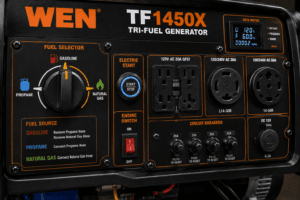
WEN TF1450X Tri-Fuel Generator

Why We Picked It
The WEN TF1450X provides impressive output and true tri-fuel capability at a price that’s often lower than many competing high-output generators.
It offers enough capacity for refrigerators, freezers, furnaces, sump pumps, lighting, and many additional household appliances during emergency outages.
Pros
- Affordable
- Tri-fuel capability
- Electric start
- Good surge capacity
- Excellent value
- Transfer switch compatible
Cons
- Louder than inverter generators
- Heavier than smaller portable models
Best For
- Budget-conscious homeowners
- Emergency preparedness
- Medium-sized homes
- Backup power
Best Value Tri-Fuel Generator
Firman T08073 Tri-Fuel Generator

Why We Picked It
The Firman T08073 has become a popular choice for homeowners seeking dependable tri-fuel performance without premium pricing. It offers solid power output, electric start, multiple outlet options, and dependable emergency performance.
Its balance of price, features, and reliability makes it one of the strongest overall values in the tri-fuel category.
Pros
- Excellent overall value
- Tri-fuel capability
- Electric start
- Long runtime
- Easy maintenance
- Reliable engine
Cons
- Louder than enclosed inverter generators
- Lower output than the largest tri-fuel models
Best For
- Families
- Medium-sized homes
- Storm preparedness
- Everyday backup power
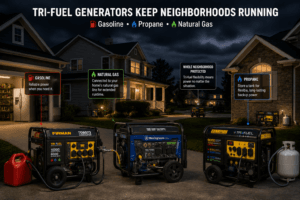
Tri-Fuel Generator Comparison
| Generator | Fuel Types | Best For |
|---|---|---|
| DuroMax XP13000HXT | Gasoline / Propane / Natural Gas | Best Overall |
| Champion 9000-Watt Tri-Fuel Inverter | Gasoline / Propane / Natural Gas | Best Inverter |
| Westinghouse WGen11500TFc | Gasoline / Propane / Natural Gas | Best High Output |
| WEN TF1450X | Gasoline / Propane / Natural Gas | Best Budget |
| Firman T08073 | Gasoline / Propane / Natural Gas | Best Value |
Modern tri-fuel generators provide unmatched flexibility by allowing homeowners to switch between three different fuel sources depending on availability. Keep in mind that output is generally highest on gasoline and somewhat lower when operating on propane or natural gas.
Comparing Fuel Types
Gasoline
Advantages:
- Highest power output
- Easy to find
- Simple refueling
Disadvantages:
- Limited shelf life
- Requires fuel stabilizer
- Should be rotated regularly
Propane
Advantages:
- Stores for years
- Cleaner burning
- Lower engine maintenance
- Excellent emergency fuel
Disadvantages:
- Slightly reduced power output
- Requires propane cylinders
Natural Gas
Advantages:
- Continuous fuel supply
- No refueling required
- Ideal for extended outages
- Excellent for home backup
Disadvantages:
- Requires a natural gas connection
- Slightly lower power output than gasoline
Home Backup Safety Tips
Always operate your tri-fuel generator safely.
- Operate generators outdoors only.
- Keep generators well away from doors, windows, garages, and vents.
- Never operate a generator inside your home or garage.
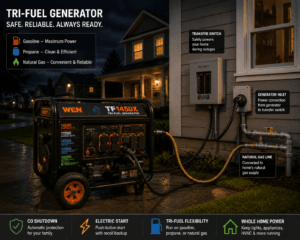
- Use a properly installed transfer switch or interlock kit when powering household circuits.
- Allow the engine to cool before refueling.
- Inspect fuel hoses before each use.
- Test your generator before storm season.
Even generators equipped with CO shutdown technology must always be used outdoors in accordance with the manufacturer’s instructions.
Which Tri-Fuel Generator Is Best?
Choose the DuroMax XP13000HXT If:
- You want the best overall tri-fuel generator
- You need maximum surge power
- You have a well pump
- Fuel flexibility is important
Choose the Champion 9000-Watt Tri-Fuel Inverter Generator If:
- Quiet operation is important
- You power sensitive electronics
- You want inverter technology
- Fuel flexibility matters
Choose the Westinghouse WGen11500TFc If:
- You have a large home
- You want maximum portable output
- Low THD is important
- You operate multiple large appliances
Choose the WEN TF1450X If:
- Budget is your priority
- You want true tri-fuel capability
- You need dependable emergency backup
- You have a medium-sized home
Choose the Firman T08073 If:
- You want excellent value
- Reliable performance is important
- You need emergency backup
- You prefer a balanced feature set
Features to Look For
Tri-fuel generators offer one of the most flexible backup power solutions available. The ability to switch between gasoline, propane, and natural gas gives homeowners multiple fueling options during emergencies, making these generators especially valuable for extended power outages.
Before purchasing, compare these important features.
True Tri-Fuel Capability
The biggest advantage of a tri-fuel generator is fuel flexibility.
It can operate on:
- Gasoline
- Propane
- Natural gas
Benefits include:
- Greater emergency preparedness
- Multiple fueling options
- Easier operation during fuel shortages
- Longer propane storage
- Continuous operation on natural gas (where available)
Remember that most tri-fuel generators produce their highest output on gasoline, with slightly reduced power when running on propane or natural gas.
High Starting Wattage
Choose a generator with enough surge capacity for appliances with electric motors.
These include:
- Refrigerators
- Freezers
- Well pumps
- Sump pumps
- Furnace blowers
- Air conditioners
Extra surge capacity helps prevent overloads during startup.
120/240-Volt Output
Most home backup generators should provide both:
- 120V outlets
- 120/240V outlets
This allows them to operate:
- Well pumps
- Transfer switches
- Interlock kits
- Large household appliances
Always verify outlet compatibility before purchasing.
Electric Start
Electric start provides:
- Push-button operation
- Faster emergency startup
- Easier cold-weather starting
- Less physical effort
Many premium models also include remote start.
Long Runtime
Compare:
- Fuel tank size
- Runtime at 25% load
- Runtime at 50% load
Natural gas offers the advantage of continuous fuel delivery where utility service remains available.
Low Total Harmonic Distortion (THD)
If you plan to power sensitive electronics, look for generators with low THD.
Benefits include:
- Safe operation for computers
- Better television performance
- Reliable internet equipment
- Protection for modern electronics
Several newer tri-fuel inverter models provide low THD while maintaining high output.
Carbon Monoxide (CO) Shutdown
Many modern portable generators include carbon monoxide detection.
If unsafe CO levels are detected around the generator, the engine automatically shuts down.
Always operate portable generators outdoors. Never use one inside a home, garage, basement, shed, crawl space, or any enclosed area. Position it well away from doors, windows, and vents.
Transfer Switch Compatibility
A properly installed transfer switch or interlock kit allows your generator to safely power household circuits.
Benefits include:
- Safe operation
- Easier connection
- Protection against dangerous backfeeding
- Reliable whole-home emergency power
Common Buying Mistakes
Avoid these common mistakes before purchasing a tri-fuel generator.
Buying Too Small
Many homeowners calculate only running watts.
Also include:
- Starting watts
- Well pump startup
- Furnace blower
- Refrigerator compressor
- Future electrical needs
Additional reserve capacity improves reliability.
Assuming All Fuels Produce the Same Power
Generator output changes depending on the fuel being used.
Generally:
- Gasoline produces the highest output.
- Propane produces slightly less.
- Natural gas usually produces the lowest output.
Always size your generator based on the fuel you expect to use most often.
Forgetting Fuel Hose Compatibility
Before an emergency:
- Inspect fuel hoses.
- Verify regulator connections.
- Check natural gas fittings.
- Replace damaged hoses immediately.
Ignoring Maintenance
Routine maintenance keeps generators dependable.
Regularly:
- Change engine oil
- Replace air filters
- Inspect spark plugs
- Exercise the generator monthly
- Test electric-start batteries
- Inspect fuel lines and regulators
Preventive maintenance improves long-term reliability.
Waiting Until Storm Season
Generator demand often increases before:
- Hurricanes
- Ice storms
- Tornado season
- Winter storms
- Severe thunderstorms
Buying early allows time to:
- Install a transfer switch
- Learn proper operation
- Store emergency fuel
- Test your generator
- Complete maintenance before severe weather arrives
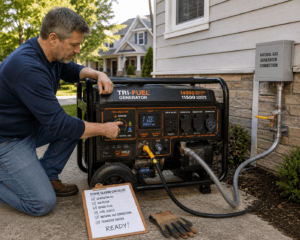
Frequently Asked Questions
What is a tri-fuel generator?
A tri-fuel generator can operate on:
- Gasoline
- Propane
- Natural gas
This flexibility allows homeowners to switch fuels based on availability during an emergency.
Is a tri-fuel generator better than a dual-fuel generator?
For many homeowners, yes.
Tri-fuel generators offer the same gasoline and propane capability as dual-fuel models while adding natural gas compatibility, making them especially attractive for homes with a natural gas connection.
Does a tri-fuel generator lose power on natural gas?
Yes.
Most generators produce their highest wattage on gasoline. Running on propane or natural gas typically results in slightly lower running and starting wattage, so size the generator accordingly.
Can a tri-fuel generator run my entire house?
It depends on:
- Generator size
- Home electrical demand
- HVAC systems
- Well pumps
- Air conditioning
- Transfer switch configuration
Many large tri-fuel generators can power most essential household circuits.
Is natural gas better than gasoline?
Each fuel has advantages.
Natural gas offers:
- Continuous fuel supply
- No refueling
- Cleaner combustion
- Excellent convenience
Gasoline offers:
- Highest power output
- Easy portability
- Wide availability
Propane provides long-term storage and cleaner operation, making it another excellent emergency fuel.
How often should I exercise my tri-fuel generator?
Run your generator about once each month under load to verify proper operation, lubricate engine components, and ensure it’s ready for emergencies.
Final Thoughts
Tri-fuel generators offer one of the most versatile backup power solutions available for homeowners. The ability to operate on gasoline, propane, or natural gas provides valuable flexibility during emergencies, helping ensure you can continue producing electricity even if one fuel becomes difficult to obtain.
For most homeowners, the DuroMax XP13000HXT remains the best overall tri-fuel generator thanks to its excellent power output, dependable performance, and outstanding fuel flexibility. Homeowners who prefer quieter operation and cleaner power should consider the Champion 9000-Watt Tri-Fuel Inverter Generator, while the Westinghouse WGen11500TFc is an excellent choice for larger homes with higher electrical demands. Budget-conscious buyers will appreciate the WEN TF1450X, and the Firman T08073 continues to deliver an excellent balance of price, features, and reliability.
Before purchasing, calculate your home’s running and starting wattage requirements, determine which fuel source you’ll use most often, and choose a generator with enough reserve capacity to power both your current and future emergency electrical needs. A properly sized tri-fuel generator can provide dependable backup power for years while giving you the flexibility to adapt to changing fuel availability.