How to Choose a Generator in 2026: The Complete Beginner’s Guide
Buying your first generator can feel overwhelming. With so many options—including portable generators, inverter generators, standby generators, solar generators, dual-fuel models, and tri-fuel generators—it’s easy to wonder which one is actually right for your home.
The good news is that choosing the right generator doesn’t have to be complicated. Once you understand your power needs, fuel options, and the differences between generator types, you can confidently select a generator that keeps your family safe and comfortable during power outages.
Whether you’re preparing for hurricanes, winter storms, tornadoes, severe thunderstorms, or unexpected blackouts, this beginner’s guide will walk you through everything you need to know before buying a generator in 2026.
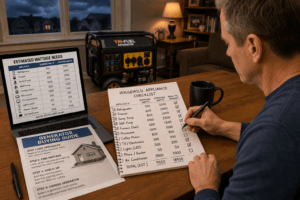
Quick Generator Buying Checklist
Before shopping, answer these questions:
✓ What appliances do I need to power?
✓ How many running watts do I need?
✓ How many starting watts do I need?
✓ Portable or whole-house generator?
✓ Gasoline, propane, natural gas, or solar?
✓ How long do I need backup power?
✓ Will I use a transfer switch?
✓ What’s my budget?
Answering these questions first will make choosing a generator much easier.
Step 1: Decide What You Need to Power
Start by making a list of everything you want to use during a power outage.
Common appliances include:
- Refrigerator
- Freezer
- Furnace blower
- Sump pump
- Well pump
- Microwave
- Television
- Internet router
- Wi-Fi
- Medical equipment
- Lighting
- Coffee maker
- Garage door opener
The more appliances you want to operate, the larger your generator will need to be.
Step 2: Understand Running Watts vs Starting Watts
This is one of the most important concepts in generator shopping.
Running Watts
Running watts are the electricity an appliance uses while operating normally.
Starting Watts
Many appliances with electric motors require extra power for a few seconds when starting.
Examples include:
- Refrigerators
- Freezers
- Well pumps
- Sump pumps
- Air conditioners
- Furnace blowers
Your generator must handle both running and starting wattage.
Step 3: Choose the Right Generator Type
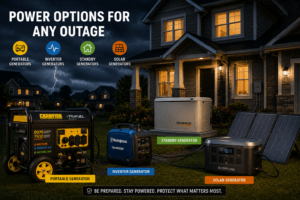
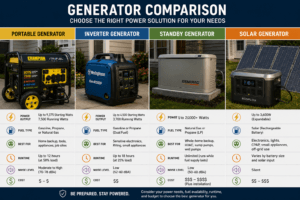
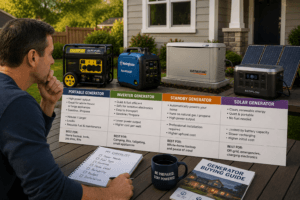
There are four primary generator categories.
Portable Generators
Best for:
- Emergency home backup
- Job sites
- Camping
- Outdoor events
Advantages:
- Affordable
- Powerful
- Portable
- Wide range of sizes
Disadvantages:
- Manual setup
- Louder than inverter generators
- Requires refueling
Inverter Generators
Best for:
- Home backup
- Electronics
- RV camping
- Quiet neighborhoods
Advantages:
- Quiet operation
- Clean electricity
- Better fuel economy
- Safe for sensitive electronics
Disadvantages:
- Higher purchase price
- Lower maximum output than many open-frame generators
Whole-House Standby Generators
Best for:
- Automatic backup
- Large homes
- Frequent outages
Advantages:
- Automatic startup
- Natural gas or propane
- Whole-home protection
- No extension cords
Disadvantages:
- Higher cost
- Professional installation required
Solar Generators
Best for:
- Indoor emergency power
- Apartments
- Renewable energy
- Quiet backup
Advantages:
- Silent operation
- No fuel
- Indoor-safe operation
- Minimal maintenance
Disadvantages:
- Limited runtime
- Higher cost for large-capacity systems
- Slower solar recharging during cloudy weather
Step 4: Choose Your Fuel Type
Gasoline
Advantages:
- Widely available
- High power output
Disadvantages:
- Short shelf life
- Requires fuel stabilizer
Propane
Advantages:
- Stores for years
- Cleaner burning
- Lower maintenance
Disadvantages:
- Slightly lower power output
Natural Gas
Advantages:
- Continuous fuel supply
- Excellent for standby generators
Disadvantages:
- Requires natural gas service
Tri-Fuel
Can operate on:
- Gasoline
- Propane
- Natural gas
Provides maximum flexibility during emergencies.
Step 5: Choose the Right Size
General recommendations:
| Home Type | Recommended Generator |
|---|---|
| Apartment | 2,000–3,000 Watts |
| Small Home | 3,500–5,000 Watts |
| Medium Home | 5,000–7,500 Watts |
| Large Home | 7,500–12,000 Watts |
| Whole-House Backup | 14kW–26kW Standby |
Always calculate both running and starting wattage before purchasing.
Step 6: Look for the Right Features
Modern generators offer many features that improve convenience, safety, and reliability.
Here are the most important ones to consider.
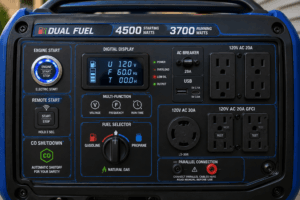
Electric Start
Instead of pulling a recoil cord, electric start allows you to start the generator with the push of a button.
Benefits include:
- Easier startup
- Faster operation
- Better for cold weather
- Less physical effort
Many premium generators also include remote start.
Dual-Fuel Capability
Dual-fuel generators operate on:
- Gasoline
- Propane
Benefits include:
- More fuel options
- Longer propane storage
- Cleaner engine operation
- Better emergency preparedness
Tri-Fuel Capability
Tri-fuel generators operate on:
- Gasoline
- Propane
- Natural gas
This gives homeowners the greatest flexibility during extended outages.
Carbon Monoxide (CO) Shutdown
Many modern generators include built-in carbon monoxide monitoring.
If unsafe CO levels are detected around the generator, it automatically shuts down.
Although this is an excellent safety feature, generators should always be operated outdoors.
Low Total Harmonic Distortion (THD)
If you plan to power:
- Computers
- Televisions
- Gaming systems
- Medical equipment
- Internet routers
choose a generator with low THD or inverter technology.
Clean power helps protect sensitive electronics.
Step 7: Decide How You’ll Connect It
There are three common ways to power your home.
Extension Cords
Best for:
- Refrigerators
- Freezers
- Lamps
- Small appliances
Advantages:
- Lowest cost
- Simple setup
Disadvantages:
- Cords throughout the house
- Limited convenience
Transfer Switch
A transfer switch connects selected household circuits directly to the generator.
Benefits include:
- Safer operation
- Easier power management
- Cleaner installation
- Better convenience
Professional installation is recommended.
Interlock Kit
An interlock kit works with your home’s electrical panel to safely connect a portable generator.
Benefits include:
- Lower cost than many transfer switches
- Safe operation
- Powers multiple household circuits
Installation should comply with local electrical codes.
Step 8: Understand Generator Safety
Before purchasing, understand these essential safety rules.
Always:
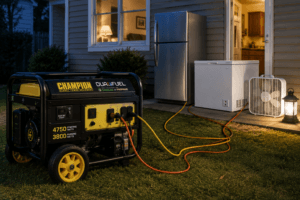
- Operate generators outdoors.
- Keep generators well away from doors and windows.
- Install carbon monoxide alarms.
- Allow the engine to cool before refueling.
- Use heavy-duty outdoor extension cords.
- Test your generator monthly.
- Read the owner’s manual.
Never:
- Operate a generator inside your home.
- Operate it in a garage.
- Plug it into a wall outlet (backfeeding).
- Refuel while it’s running.
- Operate it in standing water.
Common Generator Buying Mistakes
Avoid these mistakes.
Buying Too Small
Many homeowners forget starting watts.
Always calculate:
- Running watts
- Starting watts
Buying Too Large
Oversized generators:
- Cost more
- Consume more fuel
- Weigh more
- Take up additional storage space
Choose a generator that matches your actual electrical needs.
Ignoring Fuel Availability
Consider:
- Is gasoline easy to obtain?
- Do you already own propane tanks?
- Does your home have natural gas?
Fuel availability can be just as important as generator size.
Forgetting Maintenance
Plan for:
- Oil changes
- Air filter replacement
- Monthly exercise
- Fuel storage
- Battery maintenance
Routine maintenance helps ensure dependable operation.
Recommended Generators by Budget
Under $700
Good for:
- Apartments
- Electronics
- Small refrigerators
Examples:
- WEN DF360iX
- Predator 3500 Inverter
$700–$1,500
Good for:
- Small homes
- Essential appliances
Examples:
- Westinghouse iGen5000DFc
- Champion 7500-Watt Dual Fuel
$1,500–$3,000
Good for:
- Medium and large homes
- Well pumps
- Heavy appliance loads
Examples:
- DuroMax XP13000HXT
- Westinghouse WGen11500TFc
- Champion 9000-Watt Tri-Fuel Inverter
$3,000+
Good for:
- Automatic whole-home backup
Examples:
- Generac Guardian 22kW
- Kohler 20RESCL
- Briggs & Stratton 26kW PowerProtect
Before You Buy
Ask yourself:
✓ What appliances do I need to power?
✓ Have I calculated both running and starting watts?
✓ Which fuel will I use?
✓ Do I need quiet inverter power?
✓ Will I install a transfer switch?
✓ How long do I need backup power?
✓ Do I expect my power needs to grow?
Answering these questions helps narrow your options and prevents expensive mistakes.
Frequently Asked Questions
What size generator do I need?
The correct size depends on the appliances you plan to operate during a power outage.
General recommendations:
- 2,000–3,000 watts — Basic electronics and a small refrigerator
- 3,500–5,000 watts — Essential household appliances
- 5,000–7,500 watts — Most homes
- 7,500–12,000 watts — Large homes
- 14kW–26kW+ — Whole-house standby generators
Always calculate both running watts and starting watts before purchasing.
Should I buy an inverter generator or a conventional generator?
For most homeowners:
Choose an inverter generator if you want:
- Quiet operation
- Better fuel economy
- Clean power for electronics
- Camping or RV use
Choose a conventional portable generator if you want:
- Maximum power
- Lower purchase price
- Heavy-duty backup power
Is a standby generator worth the cost?
If you experience frequent or long power outages, many homeowners find standby generators worthwhile because they offer:
- Automatic startup
- Whole-home protection
- No extension cords
- Natural gas or propane operation
- Increased convenience
- Potential home value benefits
However, they require professional installation and a significantly higher upfront investment than portable generators.
Is dual-fuel better than gasoline only?
For many homeowners, yes.
Dual-fuel generators provide:
- Gasoline
- Propane
Advantages include:
- More fuel choices
- Longer propane storage
- Cleaner engine operation
- Better emergency flexibility
Is tri-fuel even better?
If your home has natural gas service, a tri-fuel generator can provide even greater flexibility.
It operates on:
- Gasoline
- Propane
- Natural gas
This can allow extended operation without storing large amounts of gasoline.
How much should I spend?
General price ranges:
Under $700
Good for:
- Apartments
- Camping
- Basic emergency backup
$700–$1,500
Good for:
- Small homes
- Essential appliances
$1,500–$3,000
Good for:
- Medium and large homes
- Well pumps
- Multiple appliances
$3,000+
Good for:
- Whole-house standby systems
- Automatic backup
- Large homes
How often should I run my generator?
Most portable generators should be exercised about once each month under load.
This helps:
- Keep fuel systems clean
- Lubricate engine components
- Maintain electric-start batteries
- Verify the generator is ready for emergencies
Always follow the maintenance schedule in your owner’s manual.
Can I power my whole house with a portable generator?
It depends on the generator’s output and your home’s electrical demand.
Larger portable generators connected through a properly installed transfer switch or interlock kit can often power many essential household circuits. However, whole-house standby generators are generally the best option for automatic, whole-home backup.
Final Buying Advice
If you’re still unsure which type of generator is right for you, these recommendations can help.
Choose a Portable Generator If:
- You want affordable backup power.
- You’re comfortable setting it up manually.
- You only need to power essential appliances.
Choose an Inverter Generator If:
- Quiet operation is important.
- You power sensitive electronics.
- Fuel efficiency matters.
- You also plan to use it for camping or RV trips.
Choose a Dual-Fuel Generator If:
- You want fuel flexibility.
- You already store propane.
- You want more emergency options.
Choose a Tri-Fuel Generator If:
- Your home has natural gas.
- You want maximum fuel flexibility.
- You prepare for long outages.
Choose a Whole-House Standby Generator If:
- You want automatic backup.
- You experience frequent outages.
- You want nearly seamless whole-home protection.
- Budget is less of a concern than convenience.
Choose a Solar Generator If:
- You need quiet indoor-safe backup.
- You mainly power electronics and small appliances.
- You want renewable energy with minimal maintenance.
- You prefer a battery-powered solution.
Final Thoughts
Choosing a generator doesn’t have to be confusing. By identifying the appliances you need to power, calculating your running and starting wattage requirements, selecting the right fuel type, and understanding the differences between portable, inverter, standby, and solar generators, you can confidently invest in a backup power solution that fits your home and budget.
For many homeowners, a quality dual-fuel or tri-fuel portable generator provides an excellent balance of affordability, flexibility, and emergency preparedness. Those who prioritize quiet operation and clean electricity should consider an inverter generator, while homeowners seeking maximum convenience and automatic protection may find a whole-house standby generator to be the best long-term investment.
No matter which generator you choose, remember that preparation is just as important as the equipment itself. Practice safe operation, perform regular maintenance, test your generator before storm season, and store fuel properly. A well-chosen and well-maintained generator can provide dependable backup power for many years, helping keep your family safe, comfortable, and connected whenever the power goes out.
📋 Copy Tags
how to choose a generator, generator buying guide, beginner generator guide, generator guide 2026, portable generator, inverter generator, standby generator, solar generator, dual fuel generator, tri fuel generator, home backup power, emergency generator, generator sizing guide, generator safety, power outage preparedness, Power4Everything