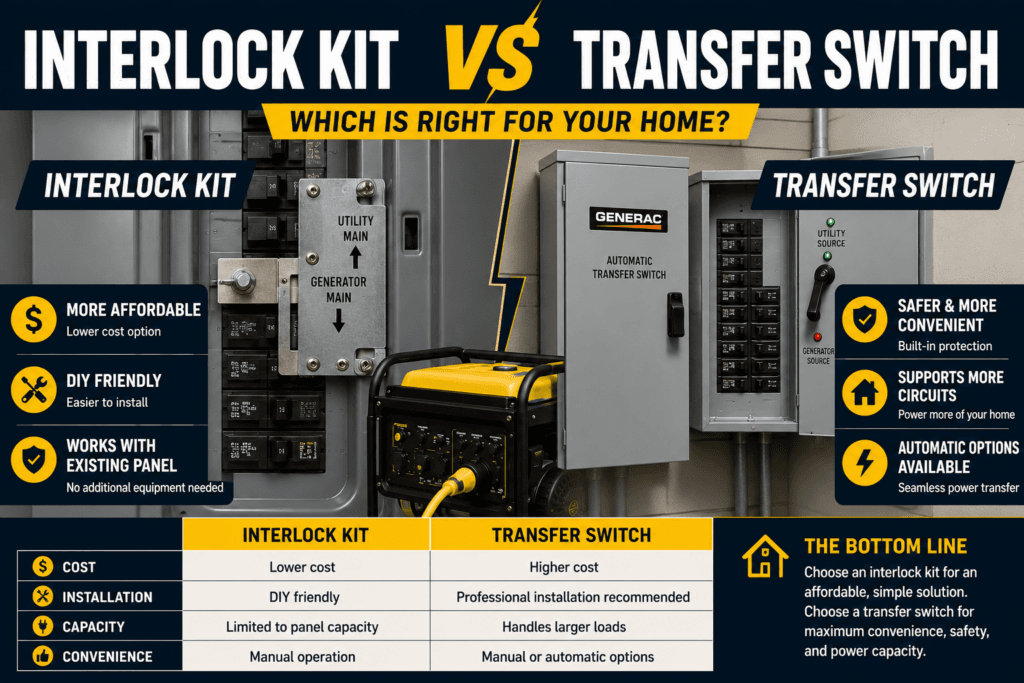
If you’re planning to connect a portable generator to your home, one of the biggest decisions you’ll face is choosing between an interlock kit and a transfer switch. Both options provide a safe way to connect a generator to your home’s electrical system while preventing dangerous backfeeding into utility power lines.
So which one is better?
The answer depends on your budget, the size of your generator, how many circuits you want to power, and how convenient you want the system to be.
In this guide, we’ll compare interlock kits and transfer switches side by side so you can choose the best solution for your home.
What Is an Interlock Kit?
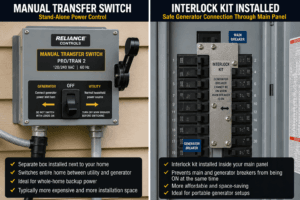
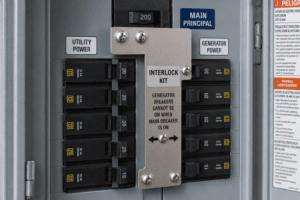
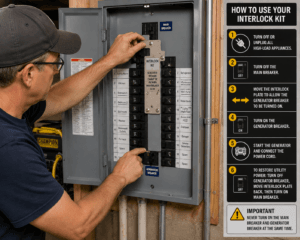
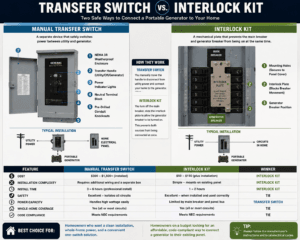
An interlock kit is a mechanical device installed on your home’s electrical panel that prevents the main breaker and the generator breaker from being turned on at the same time.
This simple safety feature eliminates dangerous backfeeding while allowing generator power to flow into your home’s breaker panel.
Instead of selecting individual circuits ahead of time, you can choose which breakers to turn on while staying within your generator’s power capacity.
What Is a Transfer Switch?
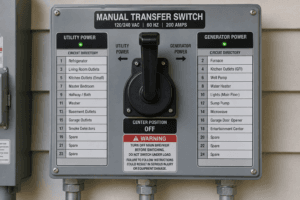
A transfer switch is a separate electrical device installed next to your main electrical panel.
It contains dedicated switches for specific household circuits, allowing you to safely transfer those circuits from utility power to generator power.
Transfer switches are commonly installed with portable generators and are also used with whole-house standby generators.
Side-by-Side Comparison
| Feature | Interlock Kit | Transfer Switch |
|---|---|---|
| Prevents Backfeeding | ✅ | ✅ |
| Works with Portable Generators | ✅ | ✅ |
| Powers Selected Circuits | ⚠️ (You choose breakers) | ✅ |
| Easier for Beginners | ❌ | ✅ |
| Lower Equipment Cost | ✅ | ❌ |
| Uses Existing Breaker Panel | ✅ | ❌ |
| Cleaner Operation | ⚠️ | ✅ |
| Often Expands Easily | ✅ | Limited by switch size |
Advantages of an Interlock Kit
Many homeowners choose an interlock kit because it offers:
- Lower installation cost
- Uses your existing electrical panel
- Can power many household circuits (within generator capacity)
- Fewer additional components
- Flexible circuit selection during outages
This flexibility makes interlock kits especially attractive for homeowners who already understand their electrical panel.
Advantages of a Transfer Switch
Transfer switches remain one of the most popular options because they provide:
- Clearly labeled emergency circuits
- Simple operation
- Organized installation
- Excellent choice for families
- Easy switching during outages
- Reduced chance of operator error
If multiple family members may operate the generator, a transfer switch is often easier to use.
Which Costs Less?
In many cases:
Interlock Kit
- Lower equipment cost
- Often fewer installation materials
- Uses existing breaker panel
Transfer Switch
- Higher equipment cost
- Separate switch enclosure
- More installation work
Actual costs vary depending on your home’s electrical system, labor rates, permits, and local code requirements.
Which Powers More Circuits?
This is where many homeowners get confused.
Transfer Switch
Most manual transfer switches include a limited number of dedicated circuits, such as six, eight, or ten.
Interlock Kit
An interlock kit allows you to energize different circuits in your main panel as long as you do not exceed your generator’s available wattage.
That flexibility can be a major advantage during extended outages.
Safety Comparison
Both systems are designed to prevent dangerous backfeeding when properly installed and used.
Regardless of which option you choose:
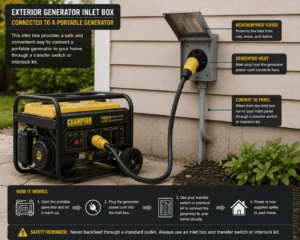
- Never plug a generator into a wall outlet.
- Always use a properly installed generator inlet box.
- Follow all manufacturer instructions.
- Operate the generator outdoors only.
- Install carbon monoxide detectors in your home.
Which One Is Easier to Use?
Transfer Switch
Generally easier.
Each circuit is labeled, making it simple to switch between utility and generator power.
Interlock Kit
Requires a better understanding of your electrical panel.
You’ll need to know which breakers to turn on while monitoring your generator’s load.
Which One Is Better for Portable Generators?
Both work well.
Choose an interlock kit if you:
- Want maximum flexibility
- Already understand your electrical panel
- Want to save money
- May power different circuits during different outages
Choose a transfer switch if you:
- Want simple operation
- Prefer dedicated emergency circuits
- Have family members who may operate the system
- Want clearly labeled controls
Common Mistakes to Avoid
Avoid these common errors:
- Installing the wrong interlock kit for your panel
- Buying an undersized transfer switch
- Overloading your generator
- Running the generator indoors
- Ignoring routine maintenance
- Using homemade backfeeding cords
- Skipping monthly generator testing
Frequently Asked Questions
Is an interlock kit as safe as a transfer switch?
When it is designed for your electrical panel, installed correctly, and used properly, an interlock kit provides effective protection against backfeeding, just like a transfer switch.
Which is less expensive?
Interlock kits are often less expensive because they use your existing breaker panel and typically require fewer components.
Can I power my whole house?
Neither option changes the amount of power your generator can produce. You can only power loads that fit within your generator’s available wattage.
Which is better for beginners?
A transfer switch is generally easier for first-time users because the circuits are clearly labeled and switching between utility and generator power is straightforward.
Do I still need a generator inlet box?
Yes. Both systems are commonly used with an exterior generator inlet box and a properly rated generator power cord.
Final Thoughts
Both interlock kits and transfer switches are excellent solutions for safely connecting a portable generator to your home. An interlock kit offers greater flexibility and can be a more economical choice, while a transfer switch provides a simple, organized system that’s especially easy for families to operate.
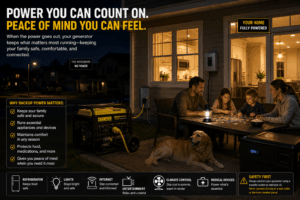
Whichever option you choose, proper installation, routine generator maintenance, and safe operating practices will help ensure reliable backup power whenever the lights go out.